
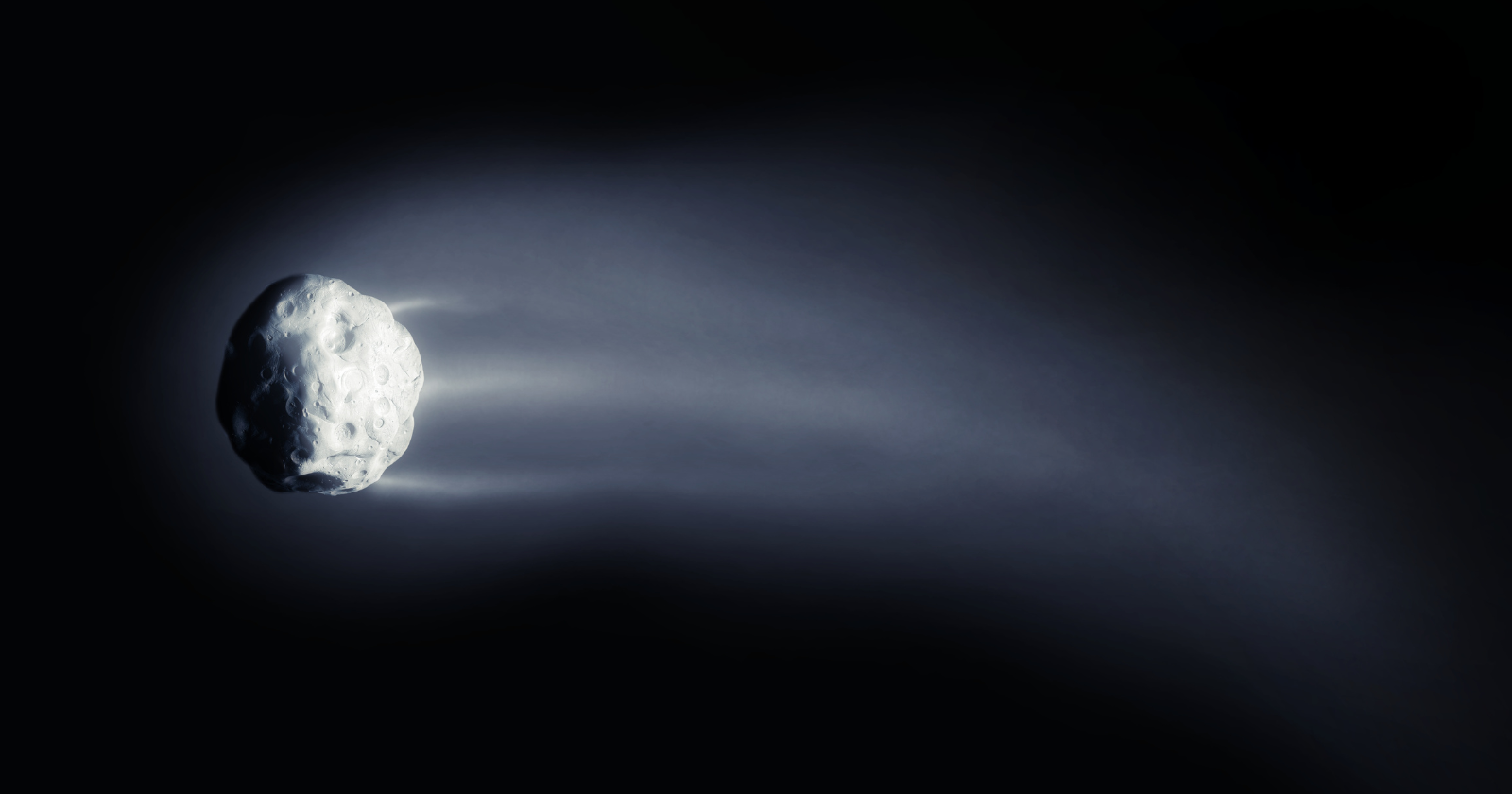
Picture a comet in a children’s drawing. There’s a bright ball racing across the sky, with a long, glowing tail flowing out behind it like the exhaust of a speeding car or the streamers on a kite.
It’s a natural way to imagine it, but it’s wrong. A comet’s tail isn’t left behind by its motion at all. It’s pushed by the Sun. And when a comet is heading away from the Sun, the tail can end up leading the way.
A dirty snowball warms up
A comet’s core, called the nucleus, is a lump of ice, rock and dust, often just a few kilometers across. For most of its long orbit, it travels through the cold outer solar system, frozen and inactive.
As it swings closer to the Sun, it heats up. Ice turns directly into gas, carrying dust with it, and forms a huge, glowing cloud around the nucleus called the coma. That cloud can grow larger than a planet.
The Sun then sweeps this material into tails, and here’s where things get interesting. Most bright comets actually have two.
Tail one: blown by the solar wind
The first is the ion tail, also called the plasma tail. Ultraviolet light from the Sun strips electrons off gas molecules in the coma, turning them into electrically charged particles called ions.
The Sun constantly blows out a stream of charged particles called the solar wind, along with its magnetic field. These sweep the comet’s ions away at very high speed. As a result, the ion tail points almost directly away from the Sun, often appearing as a straight, bluish streak.
Ion tails can be astonishingly long. In 1996, the Ulysses spacecraft unexpectedly passed through the ion tail of Comet Hyakutake, revealing that it stretched at least 570 million kilometers, more than three times the distance from Earth to the Sun.
Tail two: pushed by sunlight
The second is the dust tail. Tiny dust grains are pushed outward by the pressure of sunlight itself, a gentle but steady force called radiation pressure.
Dust grains are heavier and slower to respond than ions, so the dust tail doesn’t point quite as directly away from the Sun. Instead, it curves slightly, lagging behind along the comet’s path. Dust tails usually look broad, curved and white or yellowish, because they reflect sunlight.
In both cases, though, the main direction is the same: away from the Sun, no matter which way the comet is moving.
When the tail leads the way
That leads to the surprising part. As a comet falls inward toward the Sun, its tail streams out behind it, much as we’d expect.
But after it swings around the Sun and starts heading back out into the cold, the tail keeps pointing away from the Sun. Now the comet is moving outward too, so the tail ends up stretching out ahead of it, in the direction it’s traveling. The comet is effectively following its own tail.
The curved dust tail complicates the picture a little, since it lags along the orbit. But the overall rule holds: a comet’s tail tells you where the Sun is, not where the comet is going.
A clue to the solar wind
The behavior of comet tails helped scientists discover the solar wind. In the early 1950s, German astronomer Ludwig Biermann noticed that ion tails pointed straight away from the Sun and moved too fast to be explained by sunlight alone.
He proposed that a steady stream of particles was flowing from the Sun. Space probes later confirmed it, and the solar wind is now known to shape everything from Earth’s auroras to the magnetic bubble surrounding the solar system.
The day a comet lost its tail
Sometimes the Sun does more than shape a tail. On April 20, 2007, NASA’s STEREO-A spacecraft watched as a massive solar eruption, called a coronal mass ejection, slammed into Comet Encke near the orbit of Mercury.
The comet’s ion tail brightened, crumpled and then detached completely, carried away by the solar storm. Scientists think the tail was torn off when magnetic fields from the eruption and the comet suddenly reconnected, releasing a burst of energy. Within hours, the comet began growing a new tail from the gas around its nucleus.
Seeing it for yourself
The next time a bright comet appears in the sky, you can check this yourself. Notice where the Sun has set or is about to rise, then look at the direction of the tail. It will point away from that spot, regardless of the comet’s path.
Occasionally, from Earth’s perspective, part of the dust tail can even appear to point toward the Sun, an effect called an anti-tail. It’s an illusion caused by viewing angle. The real rule never changes: comet tails are blown by the Sun, not left behind by motion.