EA
Spacecraft · Russia
Original archive entry. The text, images and links below are kept as they were written.

EA Lander on Mars. Note the cylindrical air lock that has deployed from the belly, the landing legs, the aerodynamic surfaces on the tail, and the small Marsokhod rover on the surface.
Credit: RKK Energia
Russian manned Mars lander. Studied 1978-1986. Mars landing craft originally designed for aborted 1972 Aelita Mars study by OKB-1, and revived in the 1980's for new Energia-launched Mars expedition studies.
The EA (Expeditionary Apparatus) was a 60 metric ton cylindrical spacecraft with a conical nose.
Both conical and pear-shaped lifting bodies were studied, with a hypersonic lift to drag ratio of 0.3 to 0.5. The preferred configuration for the EA (Expeditionary Apparatus) was a cylindrical 60 metric ton spacecraft with a conical nose, 3.8 m in diameter and 13 m long. The primary braking engine was housed in the tail, and brought the spacecraft horizontally to zero velocity above the Martian surface. A landing engine at the belly of the cylinder would then fire to bring the spacecraft to a 2 m/s touchdown on four landing legs. The crew would descend to the surface in a cylindrical airlock tunnel that deployed from the belly of the cylinder to the surface. When the time came to depart, doors would open at the spine of the cylinder to reveal the vertically-launched ascent stage and crew module. From fore to aft the vehicle consisted of the conical nose, the Martian living compartment, the landing propulsion section, the return module, and the tail compartment with the braking engine. Provisions were carried for a stay of one week on the surface and one day in Mars orbit.
Related
- Family
- Mars lander
- Country
- Russia
- Agency
- Korolev bureau
Photo Gallery
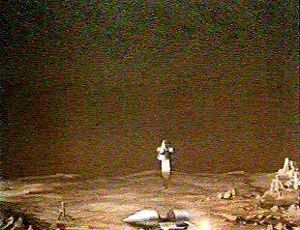
EA Ascent Stage
The Ascent Stage of the EA Mars Lander fires to launch the crew back to Mars orbit and rendezvous with the waiting Mars 1986 or 1989 expedition craft.
Credit: RKK Energia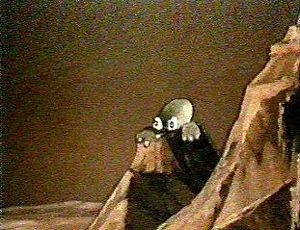
Aelita Martian
Wishful thinking - a Martian peeks from a crater after the EA Lander departs for orbit. Frame from an RKK Energia film.
Credit: RKK Energia

