Delta 1000
Launch vehicle · USA
Original archive entry. The text, images and links below are kept as they were written.

Delta 1913 no. 95 - COSPAR 1973-039
American orbital launch vehicle. The Delta 1000 series used Castor 2 strap-ons and the Extended Long Tank core with MB-3 engine.
Flyaway Unit Cost 1985$: 26.490 million.
Stage Data - Delta 1000
- Stage 0. 9 x Castor 2. Gross Mass: 4,424 kg (9,753 lb). Empty Mass: 695 kg (1,532 lb). Thrust (vac): 258.915 kN (58,206 lbf). Isp: 262 sec. Burn time: 37 sec. Isp(sl): 232 sec. Diameter: 0.79 m (2.59 ft). Span: 0.79 m (2.59 ft). Length: 6.04 m (19.81 ft). Propellants: Solid. No Engines: 1. Engine: TX-354-3. Status: In Production.
- Stage 1. 1 x Delta Thor ELT. Gross Mass: 84,067 kg (185,336 lb). Empty Mass: 4,059 kg (8,948 lb). Thrust (vac): 1,030.208 kN (231,600 lbf). Isp: 296 sec. Burn time: 222 sec. Isp(sl): 262 sec. Diameter: 2.44 m (8.00 ft). Span: 2.44 m (8.00 ft). Length: 22.40 m (73.40 ft). Propellants: Lox/Kerosene. No Engines: 1. Engine: RS-27. Other designations: Extended Length Tank Thor. Status: Out of Production.
- Stage 2. 1 x Delta P. Gross Mass: 5,434 kg (11,979 lb). Empty Mass: 820 kg (1,800 lb). Thrust (vac): 41.923 kN (9,425 lbf). Isp: 301 sec. Burn time: 322 sec. Diameter: 1.38 m (4.52 ft). Span: 1.38 m (4.52 ft). Length: 5.97 m (19.58 ft). Propellants: N2O4/Aerozine-50. No Engines: 1. Engine: TR-201. Other designations: TR-201. Status: Out of Production.
- Stage 3. 1 x Burner 2. Gross Mass: 774 kg (1,706 lb). Empty Mass: 116 kg (255 lb). Thrust (vac): 43.551 kN (9,791 lbf). Isp: 285 sec. Burn time: 42 sec. Isp(sl): 220 sec. Diameter: 0.66 m (2.16 ft). Span: 0.66 m (2.16 ft). Length: 0.84 m (2.75 ft). Propellants: Solid. No Engines: 1. Engine: Star 37. Status: Out of Production. Burner II was a launch vehicle upper stage developed by Boeing for the Air Force Space Systems Division. It was the first solid-fuel upper stage with full control and guidance capability developed for general space applications. Burner II was designed for use with the Thor booster, but was readily adapted for use on the complete range of standard launch vehicles. Its general assignment was to place small- and medium size payloads into orbit. The Burner II motor, guidance system and reaction control system were integrated to provide attitude stability and precise control of flight rate and burnout velocity for orbital injection and earth-escape missions. Boeing had delivered 8 flight vehicles under its original contract. Under terms of a follow-on contract, it built 6 additional flight models. Four Thor-Burner II combinations were launched successfully from Vandenberg Air Force Base, California. The third launch placed 2 unclassified satellites in Earth orbit. A SECOR satellite, built for the U.S. Army Corps of Engineers by the Cubic Corporation, and an Aurora satellite, developed by Rice University for the Office of Naval Research, were placed in circular orbits 3,300 km above the Earth. As integration contractor for the Air Force Space Experiment Support Program (SESP) Office, Boeing designed, built and tested the injection stage, or "payload dispenser," which carried the 2 satellites on top of a standard Burner II stage and placed them in precise orbits. The satellites were mounted on opposite sides of the injection stage, which housed a640 kgf thrust, solid-propellant rocket motor. The Burner II was used as an upper stage by NASA for deep space probes. Prime Contractor: The Boeing Company. Major Subcontractors Thiokol Chemical Corporation (solid rocket motor); Honeywell Inc. (pre-programmed inertial guidance system); Walter Kidde Co. (reaction control system).
Related
- Family
- orbital launch vehicle
- Country
- USA
- Stages
- Star 37
- Agency
- Douglas
Photo Gallery
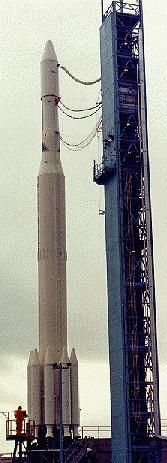
Delta 1900 no. 99
Delta 1900 no. 99 - COSPAR 1973-101
