
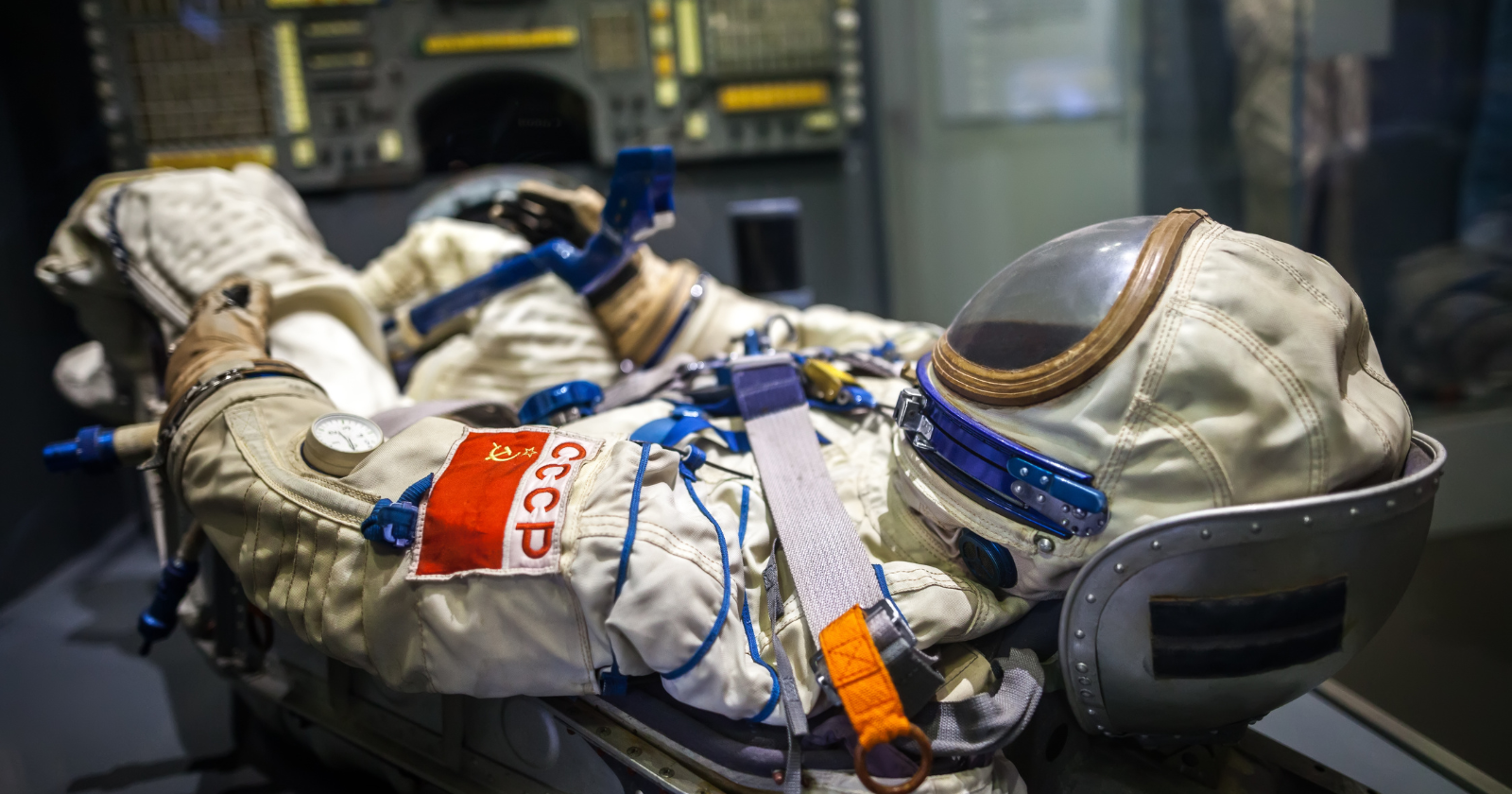
On March 25, 1961, a spacecraft came down in the snow near the Russian city of Izhevsk. Not far away, a parachute lowered a figure in a bright orange spacesuit and white helmet into a field. Local people who reached him first saw what looked like a cosmonaut lying motionless, with eyes, eyebrows and lashes, but no sign of life.
If they lifted his visor, they found the explanation printed in capital letters: МАКЕТ, Russian for “mock-up” or “dummy.” This was Ivan Ivanovich, the mannequin that flew to space twice in the weeks before Yuri Gagarin.
Rehearsing the first human spaceflight
In early 1961, the Soviet Union was racing to put the first human into orbit. Its Vostok spacecraft had a shaky record. Two test flights in December 1960 had failed, and before risking a cosmonaut, engineers needed proof that the whole system worked from launch to landing.
So they built a stand-in. Ivan Ivanovich, a name that’s roughly the Russian equivalent of “John Doe,” was made to be as lifelike as possible. He was the size and weight of a cosmonaut, wore a real spacesuit, and sat in the same ejection seat a human pilot would use.
Vostok didn’t land gently with its passenger aboard. Instead, the cosmonaut was meant to eject from the capsule during descent and parachute down separately. Ivan’s job was to prove that sequence worked, and that a body strapped into the seat would survive the trip.
Two trips around the world
Ivan’s first flight was aboard Korabl-Sputnik 4 on March 9, 1961. He shared the spacecraft with a dog named Chernushka, plus mice and a guinea pig. After a single orbit, the capsule came back down and Ivan was ejected and parachuted to Earth as planned.
Just over two weeks later, he flew again on Korabl-Sputnik 5, this time with a dog called Zvezdochka, or “Little Star.” The flight lasted under two hours and once again ended with a successful ejection and landing. With that, the Soviet engineers had their final green light. On April 12, 1961, only 18 days later, Yuri Gagarin climbed into a Vostok spacecraft and became the first human in space.
Why a mannequin needed a sign
The МАКЕТ sign wasn’t a joke. Vostok capsules and their crews were expected to come down in rural areas, often far from any recovery team. Anyone stumbling on Ivan could easily have assumed they’d found a dead pilot, or something even stranger.
The sign under his visor was there to calm that fear before it started. It also protected the secrecy around the program. A strange body in a spacesuit, discovered by villagers, could have started rumors the Soviet government would rather avoid.
The precaution proved its worth. After the second flight, Ivan landed in deep snow, and the people who found him first reportedly thought he might be a badly injured cosmonaut.
A choir and a soup recipe
The strangest part of Ivan’s missions was what he “said” on the radio. Engineers needed to test the spacecraft’s voice communication system, which meant transmitting something that sounded like speech. But they also knew Western intelligence agencies were listening closely to Soviet space signals.
A human voice reading numbers or test phrases could easily be mistaken for a real cosmonaut. That was a real worry, because rumors were already circulating in the West that the Soviets had secretly sent people into space and lost them. As the Smithsonian’s National Air and Space Museum explains, the designers settled on a compromise: a recording of a choir. Even the most gullible listener, they reasoned, wouldn’t believe a whole choir could fit inside the spacecraft.
On the second flight, they added a male voice reading out a recipe for borscht, the beetroot soup. (Some accounts say it was cabbage soup.) The idea was that no real cosmonaut would be dictating a soup recipe from orbit. So Ivan circled the Earth alternately singing and reciting cooking instructions.
Ivan’s surprising afterlife
Unlike many pieces of Soviet space hardware, Ivan survived. In 1993, as the Soviet Union’s space secrets came onto the market, he was sold at a Sotheby’s auction of Russian space history. For years afterward, he was on loan to the National Air and Space Museum in Washington, D.C., where visitors could see him in his orange suit.
His legacy lives on in other ways too. Mannequins and crash-test-style dummies are still a standard part of spacecraft testing today. Before a new capsule carries people, it often flies with an instrumented stand-in to measure the forces a human would feel.
The quiet first passenger
Gagarin’s flight rightly earned its place in history. But it rested on a lot of quieter firsts: the dogs, the mice and the guinea pigs that flew before him, and a mannequin with a printed sign under his visor and a choir in his chest.
Ivan Ivanovich never got a parade. Still, he did something no person had yet done, flying around the Earth in a Vostok spacecraft and coming home in one piece, so that the man who followed him would too.