Cosmos 1100
Spacecraft · Russia
Original archive entry. The text, images and links below are kept as they were written.
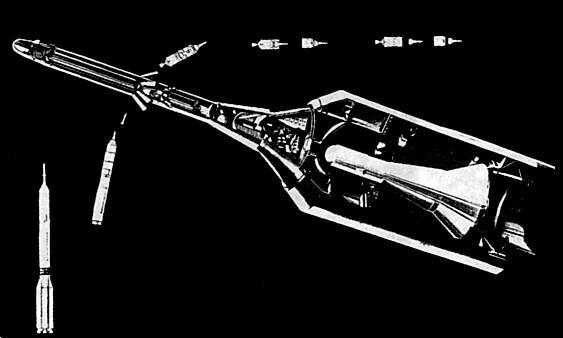
Configuration of the 82LB72 LVI dual-VA capsule test configuration. Externally the test configuration was identical with an all-up TKS ferry. The second VA, housed within the fairing, had no launch escape system and could not be rescued in the case of a launch vehicle failure.
Planned manned single-orbit flight aboard the TKS space capsule during a series of two-TKS-launched-by-one-Proton flight tests. Flown unmanned due to inability to demonstrate two consecutive failure-free launches.
The Proton launch vehicle that shut down on the original LVI-4 launch attempt was undamaged, and just a month later, with a switch of payload, LVI-4 was orbited as Cosmos 1100 and 1101. The pair launched were the 102P/102L twins from LVI-3. One capsule failed when the automatic system suffered an electrical distribution failure and it did not land correctly, spending two orbits in space, while the other landed as planned after one orbit. The launch again successfully demonstrated the reusability of the VA capsule. Plans to launch the upper capsule manned were scrubbed due to the inability to get two consecutive failure-free launches of the Proton/TKS-VA.
Related
- Country
- Russia
Chronology
1 event
1979 May 22
23:00 GMT - . Launch Site: Baikonur. Launch Complex: Baikonur LC81/24. LV Family: Proton. Launch Vehicle: Proton-K.- Cosmos 1100 - .
Payload: TKS VA s/n 102P. Mass: 4,250 kg (9,360 lb). Nation: Russia.
Agency: MOM.
Program: Almaz.
Class: Manned.
Type: Manned spacecraft. Flight: Cosmos 1100.
Spacecraft Bus: TKS.
Spacecraft: TKS VA .
Duration: 0.0600 days. Decay Date: 1979-05-23 . USAF Sat Cat: 11362 . COSPAR: 1979-042A. Apogee: 222 km (137 mi). Perigee: 193 km (119 mi). Inclination: 51.60 deg. Period: 88.60 min.
The Proton launch vehicle that shut down on the original LVI-4 launch attempt was undamaged, and just a month later, with a switch of payload, LVI-4 was orbited as Cosmos 1100 and 1101. The pair launched were the 102P/102L twins from LVI-3. One capsule failed when the automatic system suffered an electrical distribution failure and it did not land correctly, spending two orbits in space, while the other landed as planned after one orbit. The launch again successfully demonstrated the reusability of the VA capsule. Plans to launch the upper capsule manned were scrubbed due to the inability to get two consecutive failure-free launches of the Proton/TKS-VA.