
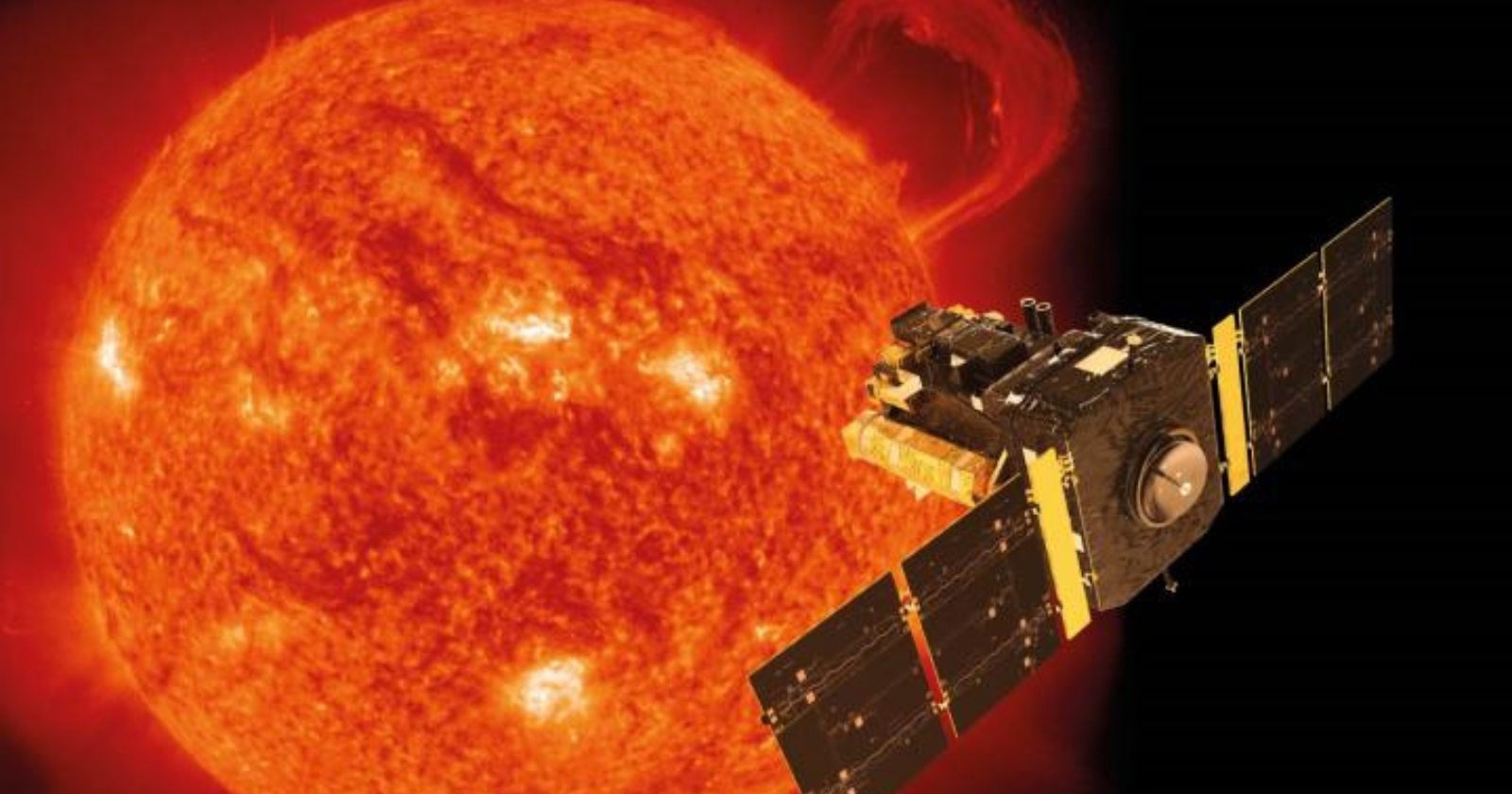
On June 25, 1998, engineers at NASA’s Goddard Space Flight Center in Maryland lost contact with one of the most important solar observatories ever built. The Solar and Heliospheric Observatory, known as SOHO, had been watching the Sun for more than two years. Now it had gone silent.
Somewhere about 1.5 million kilometers away, roughly four times farther than the Moon, the spacecraft was tumbling slowly through space, its solar panels turned away from the Sun. With no power and no signal, many feared it was gone for good.
A watchtower at L1
SOHO is a joint mission of the European Space Agency and NASA, launched on December 2, 1995. It sits near a point in space called L1, where the gravity of the Sun and Earth balance out, allowing a spacecraft to keep a constant view of the Sun.
From there, SOHO’s 12 instruments study everything from the Sun’s interior to its outer atmosphere and the solar wind. Its coronagraphs, which block out the Sun’s bright disk, became famous for capturing huge eruptions of material heading into space.
How it was lost
The trouble began during a routine maintenance and calibration activity. A series of errors in the commands sent to the spacecraft, combined with problems with its gyroscopes, which help it sense its orientation, left SOHO unable to tell how it was moving.
The spacecraft started to spin. As it turned, its solar panels lost sunlight, its batteries drained, and contact was lost. With no power for heating, its fuel and other systems began to freeze.
Finding a silent spacecraft
Finding a dead spacecraft 1.5 million kilometers away is extremely difficult. So the team turned to radar. On July 23, 1998, the giant Arecibo radio telescope in Puerto Rico, then one of the largest in the world, beamed a powerful radar signal toward where SOHO should be.
A 70-meter NASA Deep Space Network antenna in California listened for the echo. It came back. The echo confirmed SOHO was still in place and showed it was spinning slowly, about once every 53 seconds.
Thawing it back to life
On August 3, controllers picked up a faint carrier signal from SOHO, as its slowly turning panels caught enough sunlight to power the radio briefly. Over the following weeks, they carefully recharged the batteries.
Then came a delicate job. SOHO’s hydrazine fuel had frozen solid in its tank and pipes. Engineers used the spacecraft’s heaters to thaw it gradually, step by step, to avoid bursting the lines. By mid-September, they were able to fire the thrusters, stop the spin and point SOHO back at the Sun. Its instruments soon came back to life, most of them undamaged.
Saved again, without gyroscopes
SOHO’s troubles weren’t over. By the end of 1998, all three of its gyroscopes had failed. Rather than give up, engineers wrote new software that let the spacecraft keep its orientation without them.
The new system went into use in February 1999, making SOHO the first spacecraft of its kind to operate without gyroscopes. In 2003, when its main antenna got stuck, the team found another workaround and kept the data flowing.
Nearly three decades of science
SOHO was designed for just two to three years. It celebrated 30 years in space in December 2025, having watched the Sun through nearly three full 11-year solar cycles.
It became the backbone of space weather forecasting, providing early warning of solar storms heading for Earth. It also became the most successful comet hunter in history. More than 5,000 comets have been found in its images, most of them by citizen scientists. When Arecibo itself collapsed in 2020, the spacecraft it helped save was still working.
Following SOHO today
SOHO’s images are freely available online through its official website, where you can see the latest views of the Sun and its outer atmosphere. Its mission has been extended into 2026, and newer spacecraft, such as NASA’s Solar Dynamics Observatory and ESA’s Solar Orbiter, now build on its work.