
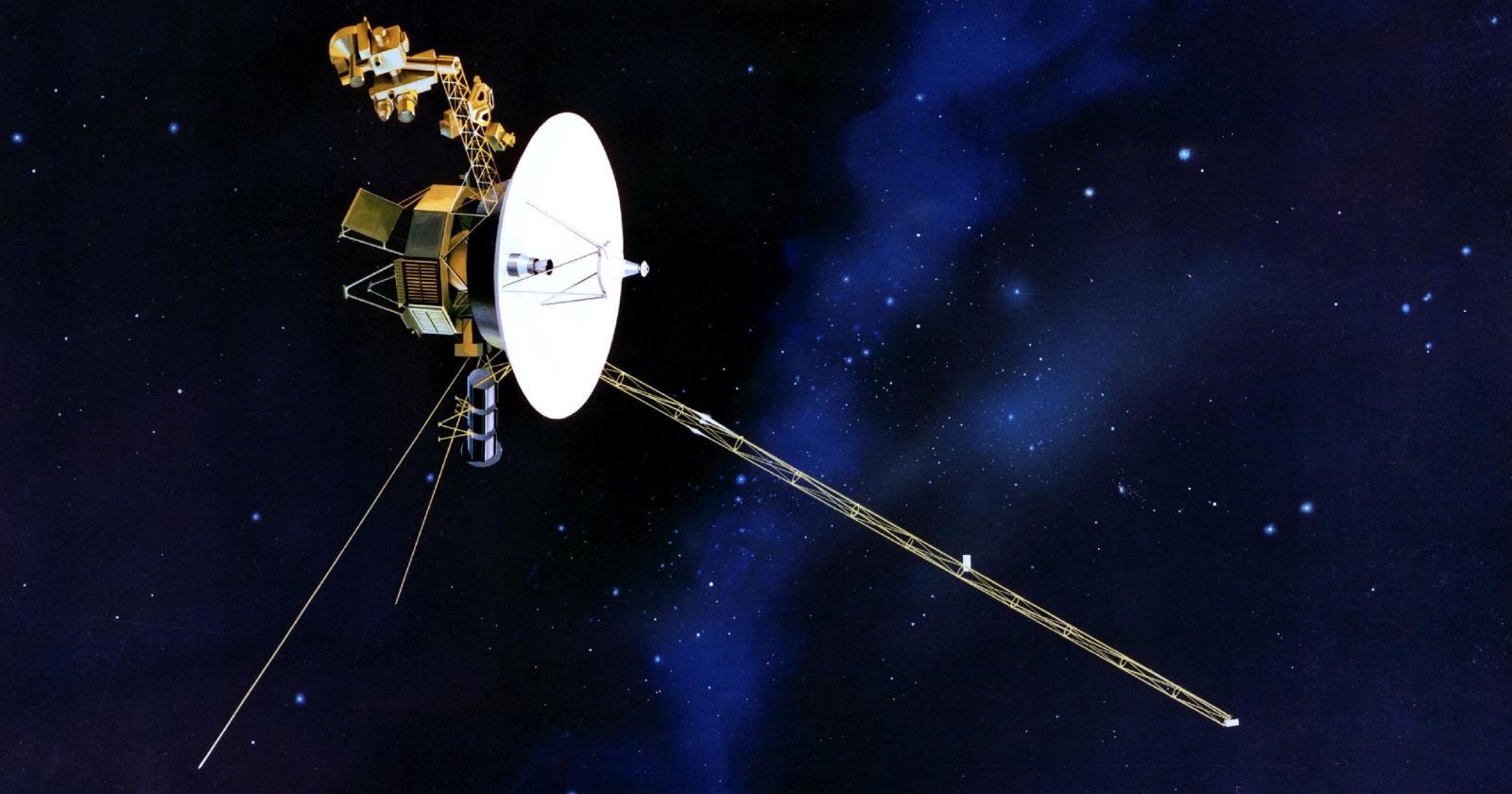
Somewhere beyond the edge of the solar system, more than 16 billion miles from Earth, a spacecraft the size of a small car is drifting through the dark. It has no GPS and no map. Its computers were designed in the early 1970s.
Yet day after day, Voyager 1 keeps its dish antenna pointed almost precisely at a tiny blue planet it can’t see, and sends its data home. The way it manages this is one of the quiet marvels of space engineering.
A computer smaller than a photo
Voyager 1 launched on September 5, 1977, followed by its twin, Voyager 2. Each carries three main computer systems, which between them hold about 69.63 kilobytes of memory. A single photo taken on a modern smartphone is typically several megabytes, many times larger.
One computer handles commands from Earth. Another packages science data for transmission. The third, the Attitude and Articulation Control System, has what may be the most important job of all: keeping the spacecraft pointed in the right direction.
Finding Earth with the Sun and a star
Voyager’s main dish antenna is 12 feet across, and it has to point at Earth very accurately. If it drifts by even a fraction of a degree, the signal can be lost.
To stay on target, Voyager uses two guides in the sky. A Sun sensor locks onto the Sun, which, from Voyager’s distance, looks like a very bright star close to Earth’s position. A star tracker locks onto Canopus, one of the brightest stars in the sky. Using those two points, Voyager knows exactly how it’s oriented in space, and keeps its antenna aimed at the Sun and Earth.
Small nudges from tiny thrusters
To correct its orientation, Voyager fires small thrusters, little jets that give short puffs of hydrazine fuel. These gentle nudges keep it steady without any need for big engines.
After nearly 50 years, the thrusters are wearing out. Residue has slowly clogged their fuel lines, so engineers have had to switch between backup sets. In 2025, the team managed to revive a set of thrusters on Voyager 1 that had been considered dead since 2004, buying the mission more time.
When pointing goes wrong
Small errors can have big consequences. In July 2023, a mistaken command tilted Voyager 2’s antenna by just 2 degrees away from Earth. Contact was lost for about two weeks, until NASA sent a powerful “shout” from a giant antenna in Australia, instructing Voyager 2 to turn back.
In 2022, Voyager 1’s attitude control system started sending back garbled data about its position. Engineers traced the problem to the system routing data through an onboard computer that had stopped working years earlier. They fixed it from billions of miles away, without the spacecraft ever losing its way.
Getting the data home
Once Voyager is pointed correctly, its radio transmitter sends data home on about 23 watts of power. By the time the signal reaches Earth, it’s unimaginably faint.
NASA’s Deep Space Network, with huge dishes in California, Spain and Australia, picks it up. Voyager also uses error-correcting codes, which add extra information to the data so mistakes caused by noise can be detected and fixed on the ground. Even so, data now trickles in at just 160 bits per second.
How much longer?
Voyager’s power comes from nuclear generators that lose a little output every year. Engineers have switched off heaters and instruments to save energy, and NASA hopes to keep at least one instrument running into the early 2030s.
Eventually, there won’t be enough power to keep the spacecraft pointed or transmitting. When that happens, Voyager will fall silent. But until then, a computer smaller than a phone photo will keep finding Earth in the dark, using the Sun and a single bright star.