
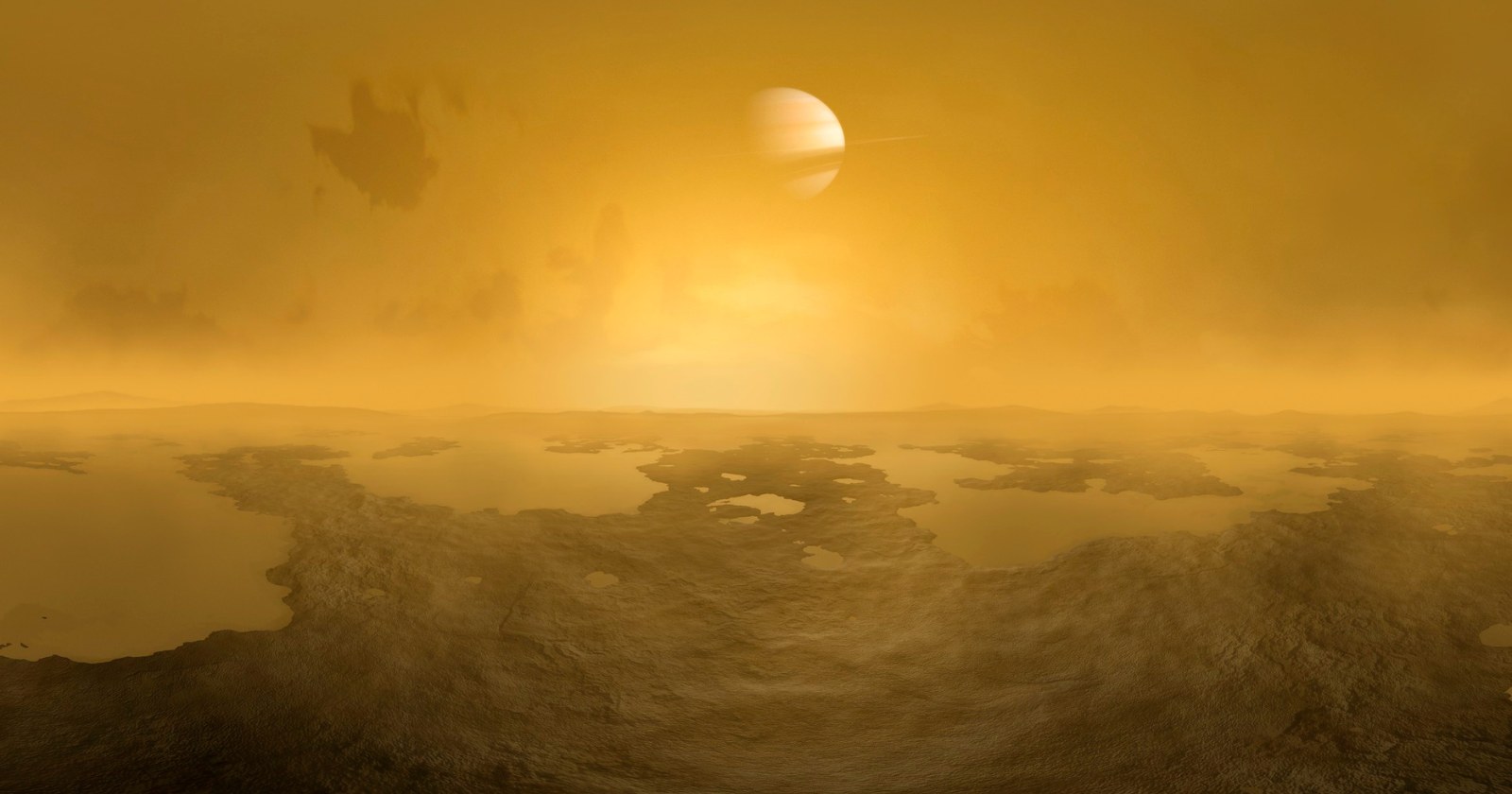
Imagine standing on a dark shoreline under a hazy orange sky. In front of you stretches a lake, still and quiet, its surface reflecting a dim, distant Sun. The ground beneath your boots is scattered with smooth, rounded pebbles, like a beach on Earth.
But nothing here is what it seems. This is Titan, Saturn’s largest moon, the only place in the solar system besides Earth known to have liquid lakes and seas on its surface.
A moon with weather
Titan is bigger than the planet Mercury. It’s the only moon in the solar system with a thick atmosphere, made mostly of nitrogen, like Earth’s, with a few percent methane.
That atmosphere creates a hazy, orange sky that hides the surface from ordinary telescopes. Titan also has weather. Methane forms clouds, falls as rain, flows through river channels and collects in lakes and seas, in a cycle much like Earth’s water cycle.
Lakes of liquid methane
At Titan’s surface, the temperature is about minus 290°F, or minus 179°C. At that temperature, methane and ethane, which are gases on Earth, become liquids.
NASA’s Cassini spacecraft, which orbited Saturn from 2004 to 2017, used radar to map hundreds of lakes and several large seas near Titan’s poles. The largest, Kraken Mare, is bigger than any lake on Earth. The seas are made mostly of liquid methane, mixed with ethane and dissolved nitrogen.
One surprise was how calm they are. Cassini’s radar often found the surfaces almost perfectly smooth. Scientists have found hints of small waves, perhaps only an inch or so high, but Titan’s lakes are mostly remarkably still.
Pebbles made of ice
In January 2005, the European Space Agency’s Huygens probe parachuted through Titan’s atmosphere and landed on its surface. It’s still the most distant landing ever made.
Its photos showed a flat plain scattered with rounded pebbles, a few inches across, much like the stones on a dried-up riverbed. But they’re not made of rock. They’re made of water ice, frozen so hard at Titan’s temperatures that it behaves like rock does on Earth. Their rounded shapes suggest they were once tumbled by flowing liquid.
Thick air and weak gravity
Titan’s atmosphere is far thicker than Earth’s. The air pressure at the surface is about 1.5 times what we feel at sea level, and because it’s so cold, the air is about four times as dense.
Meanwhile, Titan’s gravity is only about one-seventh of Earth’s. Put those together, and you get a world where flying is remarkably easy. Scientists have calculated that a person wearing a suit with wings attached could, in principle, flap them and lift off, something impossible on Earth.
You couldn’t do it without protection, though. The cold would be instantly deadly, and there’s no oxygen to breathe. But you wouldn’t need a pressure suit, because the air pressure is comfortable for a human body.
Dragonfly is on its way
Titan’s thick air and low gravity also make it ideal for flying robots. NASA’s Dragonfly mission will send a nuclear-powered rotorcraft about the size of a car to explore it.
Dragonfly is scheduled to launch in July 2028 on a SpaceX Falcon Heavy rocket and arrive in 2034. It will hop between sites across Titan’s dunes and craters, studying the chemistry of its surface. Scientists hope it will help explain how complex organic molecules form, the kind of chemistry that may have come before life on Earth.
Why Titan fascinates scientists
Titan is in many ways a frozen, alien version of the early Earth. It has weather, seas and complex chemistry, but at temperatures where water is rock and methane is rain.
Studying it helps scientists understand how planets work and where life’s building blocks might form. And it offers one of the strangest scenes imaginable: a quiet lakeshore where the ground is ice, the liquid is natural gas, and a person could fly.