
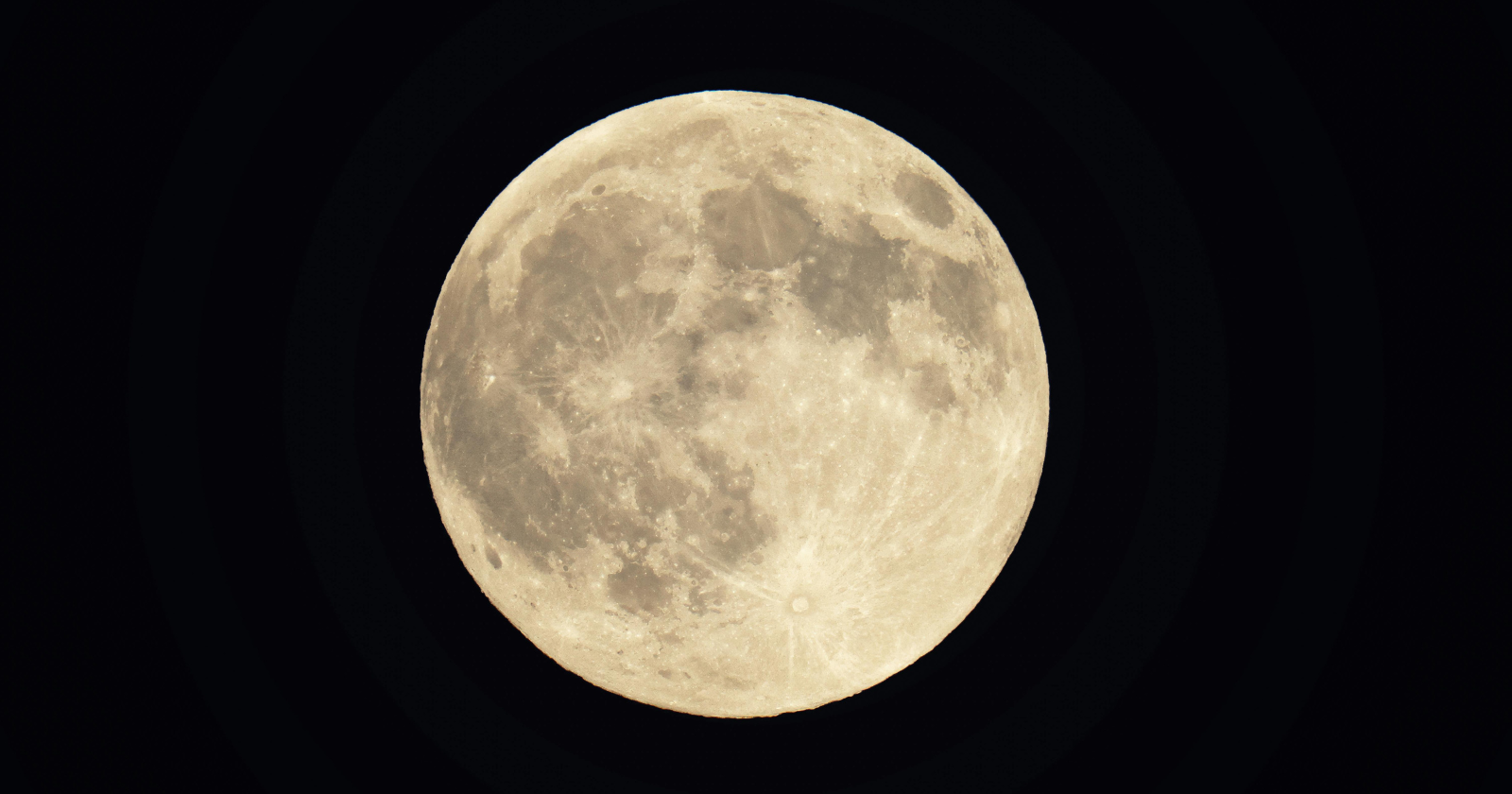
On a clear night, a full Moon can be bright enough to read by. It casts sharp shadows, washes out the stars around it, and looks almost silver-white. It’s easy to assume the surface must be made of something pale and highly reflective.
It isn’t. If you could stand on the Moon and look down, you’d be standing on ground about as dark as an old parking lot. The Moon only reflects around 12 percent of the sunlight that hits it, putting it in the same range as weathered asphalt.
What albedo tells us
Scientists measure how reflective a surface is using a number called albedo. On this scale, zero means a perfectly black surface that absorbs all light, and 1 means one that reflects everything. Fresh snow sits near the top, at around 0.8 to 0.9. Fresh black asphalt is near the bottom, at about 0.04.
The Moon comes in at roughly 0.12. In other words, about 88 percent of the sunlight hitting it is absorbed rather than bounced back. For comparison, Earth reflects about 31 percent, thanks largely to its bright clouds and ice. As physicist Christopher Baird of West Texas A&M University puts it, the Moon has about the same albedo as old asphalt on roads and parking lots.
The exact figure depends on how it’s measured, since the Moon doesn’t reflect light evenly in every direction. Some measurements come in lower, around 7 to 11 percent. Either way, the conclusion is the same: the Moon is a dark object.
Why the surface is so dark
The Moon’s surface is covered in a layer of rock dust and broken fragments called regolith, built up over billions of years of meteorite impacts. Much of it comes from dark volcanic rock, especially in the large, smooth “seas,” or maria, that form the darker patches you can see from Earth.
The lighter highland regions are made of paler rock, but even those aren’t bright by everyday standards. On top of that, the surface is constantly exposed to solar wind and tiny meteorite strikes. Over time, this “space weathering” darkens the regolith even further.
The result is a world colored mostly in dull grays and browns. Astronauts who walked on it described a landscape that looked very different from the brilliant white disc we see in our sky.
Seeing the Moon next to Earth
One of the clearest demonstrations comes from space. In July 2015, NASA and NOAA’s DSCOVR spacecraft, positioned about a million miles from Earth, captured images of the Moon passing in front of our planet. Both bodies were lit by the same sunlight from the same angle.
Next to the bright blue and white Earth, the Moon looks strikingly dark, closer to charcoal gray than silver. Astronauts on the International Space Station have taken similar photos. As one lunar observing site noted, seen from Earth orbit the Moon looks much darker than it does through a backyard telescope.
So why does it look so bright?
Part of the answer is simply that the Moon is sitting in full, unfiltered sunlight. Even a dark surface reflects a lot of light when it’s hit by sunshine that strong. A sunlit asphalt road can look surprisingly bright at midday, too.
The other part is about how your eyes and brain judge brightness. Your visual system doesn’t measure light in absolute terms. It compares things to their surroundings. At night, the Moon is by far the brightest thing in a sky that’s almost entirely black. Against that backdrop, the brain tends to treat the brightest object in view as white, even if it’s actually reflecting very little light.
You can see the effect for yourself during the day. When the Moon is visible in a blue daytime sky, it often looks pale, washed out and grayish rather than brilliant. It’s reflecting the same amount of light, but now it has much brighter surroundings to compete with.
A full Moon’s hidden boost
There’s one more twist. The Moon doesn’t just get brighter as more of it is lit. It gets dramatically brighter at full Moon. At first or last quarter, half the visible disc is lit, yet the Moon shines at only about 8 percent of the brightness of a full Moon.
Part of the reason is shadows. When the Sun is behind you, you see each grain of lunar dust lit head-on, with its shadow hidden behind it. At other phases, sunlight hits at an angle, and countless tiny shadows across the rough surface dim the overall glow. Astronomers call this surge in brightness the “opposition effect.”
A dark world that lights our nights
None of this makes the Moon any less remarkable. A ball of dark, dusty rock, roughly 240,000 miles away, still reflects enough sunlight to light up the landscape on a clear night.
It’s just a reminder that what we see in the sky isn’t always what’s really there. The silver Moon of songs and paintings is, up close, a dark gray world. It’s our eyes, and the darkness of space around it, that turn it white.