Saturn C-3
Launch vehicle · USA
Original archive entry. The text, images and links below are kept as they were written.

Credit: © Mark Wade
The launch vehicle concept considered for a time as the leading contender for the Earth Orbit Rendezvous approach to an American lunar landing.
LEO Payload: 36,300 kg (80,000 lb) to a 556 km orbit at 28.00 degrees. Payload: 13,600 kg (29,900 lb) to a translunar trajectory. Flyaway Unit Cost 1985$: 43.500 million.
Stage Data - Saturn C-3
- Stage 1. 1 x Saturn S-IB-2. Gross Mass: 725,491 kg (1,599,433 lb). Empty Mass: 68,014 kg (149,945 lb). Thrust (vac): 13,339.956 kN (2,998,941 lbf). Isp: 304 sec. Burn time: 139 sec. Isp(sl): 265 sec. Diameter: 8.25 m (27.06 ft). Span: 10.00 m (32.00 ft). Length: 34.50 m (113.10 ft). Propellants: Lox/Kerosene. No Engines: 2. Engine: F-1. Status: Study 1960.
- Stage 2. 1 x Saturn S-II-C3. Gross Mass: 204,044 kg (449,840 lb). Empty Mass: 24,938 kg (54,978 lb). Thrust (vac): 3,557.313 kN (799,716 lbf). Isp: 420 sec. Burn time: 200 sec. Isp(sl): 300 sec. Diameter: 8.25 m (27.06 ft). Span: 8.25 m (27.06 ft). Length: 21.30 m (69.80 ft). Propellants: Lox/LH2. No Engines: 4. Engine: J-2. Status: Study 1960.
- Stage 3. 1 x Saturn IV. Gross Mass: 50,576 kg (111,500 lb). Empty Mass: 5,217 kg (11,501 lb). Thrust (vac): 400.346 kN (90,001 lbf). Isp: 410 sec. Burn time: 482 sec. Diameter: 5.49 m (18.01 ft). Span: 5.49 m (18.01 ft). Length: 12.19 m (39.99 ft). Propellants: Lox/LH2. No Engines: 6. Engine: RL-10. Status: Out of Production.
Related
- Family
- orbital launch vehicle
- People
- von Braun
- Country
- USA
- Spacecraft
- Gemini
- Stages
- Saturn IV, Saturn S-IB-2, Saturn S-II-C3
Photo Gallery
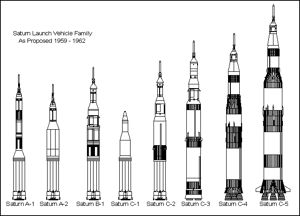
Saturn A-1 to C-5
Credit: © Mark Wade
Saturn C-3 early
Saturn C-3 early concept
Credit: © Mark Wade
Saturn C-3B 2 Stage
Saturn C-3B 2 Stage version Nov 1961
Credit: © Mark Wade
Saturn C-3B final
Saturn C-3B final configuration Nov 1961
Credit: © Mark Wade


Chronology
2 events
1961 June 20
LV Family: Saturn V. Launch Vehicle: Saturn C-3.- Donald Heaton had been appointed Chairman of an Ad Hoc Task Group - .
Nation: USA.
Program: Apollo.
Robert C. Seamans, Jr., NASA Associate Administrator, notified the Directors of Launch Vehicle Program, Space Flight Programs, Advanced Research Programs, and Life Sciences Programs that Donald H. Heaton had been appointed Chairman of an Ad Hoc Task Group. It would establish program plans and supporting resources necessary to accomplish the manned lunar landing mission by the use of rendezvous techniques, using the Saturn C-3 launch vehicle, with a target date of 1967. Guidelines and operating methods were similar to those of the Fleming Committee. Members of the Task Group would be appointed from the Offices of Launch Vehicle Programs, Space Flight Program, Advanced Research Programs, and Life Sciences Programs. The work of the Group (Heaton Committee) would be reviewed weekly. The study was completed during August.