RT-1
Missile · Russia
Original archive entry. The text, images and links below are kept as they were written.
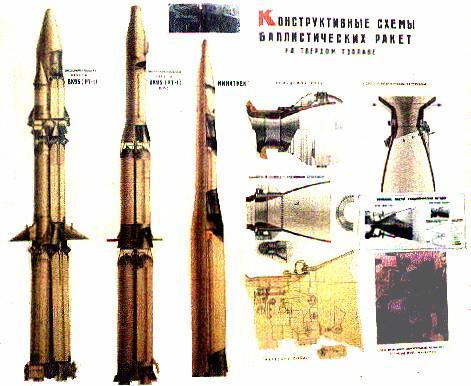
8K95 model comparison
Credit: © Mark Wade
The RT-1 (RT = rocket, solid in Russian) was the first large Soviet solid propellant ballistic missile. It was developed and tested in 1959-1963, but no production was undertaken due to its poor performance.
Although development of modern solid rocket propellants began in the United States in 1948, the Soviet Union did not follow suit. Sergei Korolev sought approval for a corresponding Soviet development, seeing solid rockets as a better answer to the military's requirements then the storable liquid propellant rockets which the Soviet technical establishment favored. He formed a basic research program for the technology within his bureau in July 1958. The US decision to develop and deploy hundreds of Minuteman and Polaris solid propellant missiles finally pushed the Soviet leadership into action. A government resolution of 27 January 1959 authorized V G Grabin at TsNII-58, under the direction of Korolev's OKB-1, to begin design of the RT-1 solid propellant long range ballistic missile, the first in the Soviet Union. OKB-1 first efforts started in August 1959. A decree of 20 November 1959 authorized Korolev to begin development of a three stage solid rocket, which was to have a range of 800 to 2500 km with an 800 kg payload and a lift-off mass of 35 metric tons. I N Sadovskiy was made OKB-1 project manager, with engines for all stages being developed and fabricated by NII-125 in Lyuberts under the direction of Boris P Zhukov. Yuri Aleksandrovich Pobendonostsev and Aleksandr Semenovich Bakayev at Zhukov's bureau had developed the OPRD-1, the Soviet Union's first large rocket motor. This had a one meter diameter and a fuel fraction of 87%, unprecedented in the Soviet Union at the time. Bundles of four 800 mm diameter versions of this motor of varying lengths would make up the three stages of the RT-1.
Test stand firings of the stages began in 1961 and the missile was ready for flight trials at Kapustin Yar in March 1962. The first test flight was on 28 April 1962. Of nine launches during the first trials series, only three were successful. The first fully successful launch did not take place until 18 March 1963, with the missile impacting near Lake Balkash. The final, unsuccessful launch in the series came in June 1963 and reached an altitude of only 2.7 km and impacted 12.4 km downrange.
Air vanes provided steering for the second stage. Range for the missile was controlled by thrust termination of the third stage. In the end it was decided not to put the missile into production due to its poor range and accuracy performance. However surplus first and second stage hardware were used in September-November 1965 in three launches of the RT-1-63 configuration. This tested several components planned for the RT-2 ICBM, including the monoblock third stage designed by SKB-172 in Perm for the RT-2 missile, 'grid stabilizers' on the second stage in place of fins, and the SM-162 transporter-launcher. The SM-162 for the RT-2 was designed by Spetsmash. The rocket was fired from a tube and arced over to a forty-five degree angle as soon as it cleared the launcher.
RT-1 artifacts may be found at Orevo, which has sectioned hardware, and Tsniimash, which has a 1:5 scale structural simulation model.
Maximum range: 2,000 km (1,200 mi). Boost Propulsion: Solid. Cruise Thrust: 500.000 kN (112,400 lbf). Cruise Thrust: 51,000 kgf. Stage 3 Thrust: 245.000 kN (55,078 lbf). Stage 3 Thrust: 25,000 kgf.
Related
- Family
- IRBM, silo-launched
- Country
- Russia
- Launch Sites
- Kapustin Yar, Kapustin Yar V-2
- Stages
- RD RT-15-2, RD RT-1-3, RT-2-1
- Agency
- Korolev bureau
Photo Gallery
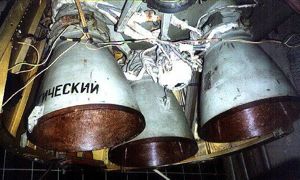
8K95 nozzles
Credit: © Mark Wade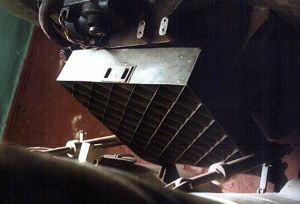
8K95 Grid stabilizer
Credit: © Mark Wade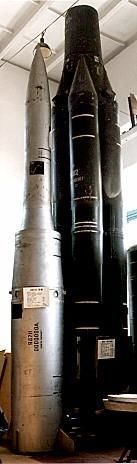
PR-90 and 8K95
Credit: © Mark Wade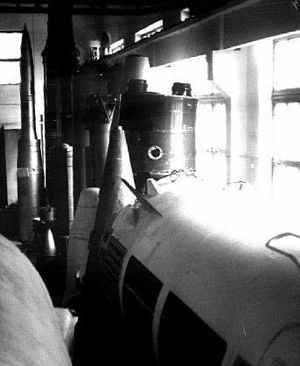
Solid rockets, Orevo
Solid rockets at Orevo 4
Credit: © Mark Wade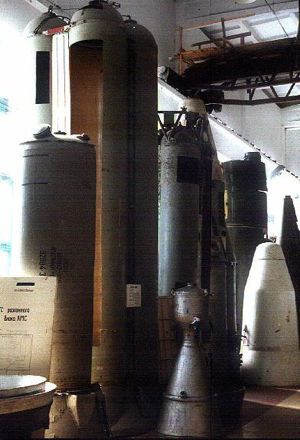
Solid rockets, Orevo
Solid rockets at Orevo 1
Credit: © Mark Wade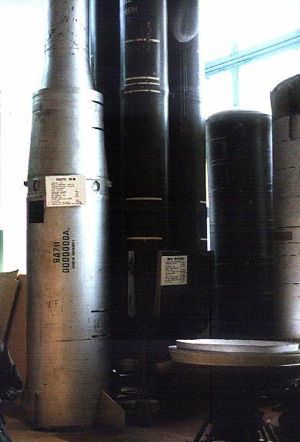
Solid rockets, Orevo
Solid rockets at Orevo 2
Credit: © Mark Wade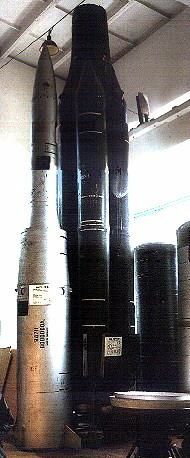
Solid rockets, Orevo
Solid rockets at Orevo 3
Credit: © Mark Wade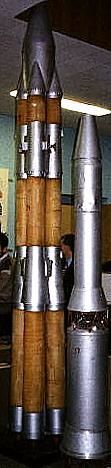
RT-1 / RT-1A ICBMs
Subscale static test models of RT-1 and RT-1A solid fuel ballistic missiles developed by Korolev in 1960's
Credit: Andy Salmon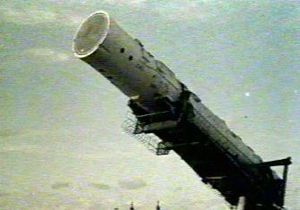
RT-1 launcher
Credit: RKK Energia


Chronology
14 events
1959 February 20
LV Family: RT-2. Launch Vehicle: RT-1.- RT-1 experimental solid propellant ballistic missile development authorised - . Nation: Russia. Related Persons: Korolev. Korolev was to begin development of the three stage rocket, which was to have a range of 800 to 2500 km and a lift-off mass of 35 tonnes..
1959 July 3
LV Family: RT-2. Launch Vehicle: RT-1.- Development of solid propellant ICBM begun. - . Nation: Russia. State Committee for Defence Technology (GKOT) Decree 'On attaching of TsNII-58 for solid-propellant work to OKB-1' was issued..
1961 April 4
LV Family: RT-2. Launch Vehicle: RT-1.- Development of the RT-2 ICBM authorised by a decree in parallel with the RT-1. - . Nation: Russia. Development of the RT-2 ICBM was authorised by a decree of 4 April 1961 in parallel with the RT-1..
1962 March 1
Launch Site: Kapustin Yar. Launch Complex: Kapustin Yar V-2. LV Family: RT-2. Launch Vehicle: RT-1. FAILURE: Failure.1962 April 28
Launch Site: Kapustin Yar. Launch Complex: Kapustin Yar V-2. LV Family: RT-2. Launch Vehicle: RT-1.1963 March 18
Launch Site: Kapustin Yar. Launch Complex: Kapustin Yar V-2. LV Family: RT-2. Launch Vehicle: RT-1.1963 June 1
Launch Site: Kapustin Yar. Launch Complex: Kapustin Yar V-2. LV Family: RT-2. Launch Vehicle: RT-1.1964?
Launch Site: Kapustin Yar. Launch Complex: Kapustin Yar V-2. LV Family: RT-2. Launch Vehicle: RT-1.1964?
Launch Site: Kapustin Yar. Launch Complex: Kapustin Yar V-2. LV Family: RT-2. Launch Vehicle: RT-1.1965
Launch Site: Kapustin Yar. Launch Complex: Kapustin Yar V-2. LV Family: RT-2. Launch Vehicle: RT-1.1965 September 1
Launch Site: Kapustin Yar. Launch Complex: Kapustin Yar V-2. LV Family: RT-2. Launch Vehicle: RT-1. FAILURE: Failure.1965 October 1
Launch Site: Kapustin Yar. Launch Complex: Kapustin Yar V-2. LV Family: RT-2. Launch Vehicle: RT-1.1965 November 1
Launch Site: Kapustin Yar. Launch Complex: Kapustin Yar V-2. LV Family: RT-2. Launch Vehicle: RT-1. FAILURE: Failure.1965 December
LV Family: RT-2. Launch Vehicle: RT-1.- Work ended on the experimental RT-1 missile. - . Nation: Russia. The tests on this missile proved concepts and hardware for the RT-2 operational solid propellant ICBM.