N-4
Spacecraft · Russia
Original archive entry. The text, images and links below are kept as they were written.

Credit: © Mark Wade
Russian cosmic ray astronomy satellite. Designated Proton 1 after launch; investigated ultra-high-energy cosmic particles.
Actual mass was 8,300 kg - but that announced at time of launch was 12,200 kg (designed payload capacity of three-stage version of original Proton launch vehicle that never flew).
Subtopics
Related
- Country
- Russia
- Launch Sites
- Baikonur, Baikonur LC81/23
- Agency
- Chelomei bureau, MOM
Photo Gallery
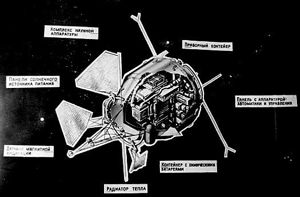
N-4 Spacecraft
Cutaway view of N-4 spacecraft. This heavy high-energy physics station was launched on the first four test launches of the Proton launch vehicle.
Credit: Chelomei School, Leninsk
Proton 1
Credit: Manufacturer Image


Chronology
4 events
1965 July 16
11:16 GMT - . Launch Site: Baikonur. Launch Complex: Baikonur LC81/23. LV Family: Proton. Launch Vehicle: UR-500.- Proton 1 - .
Payload: N-4 s/n 1. Mass: 8,300 kg (18,200 lb). Nation: Russia.
Related Persons: Chelomei.
Agency: MOM.
Program: Proton.
Class: Astronomy.
Type: X-ray astronomy satellite. Spacecraft: N-4 .
Decay Date: 1965-10-11 . USAF Sat Cat: 1466 . COSPAR: 1965-054A. Apogee: 578 km (359 mi). Perigee: 181 km (112 mi). Inclination: 63.40 deg. Period: 92.20 min.
The first launch of the Proton launch vehicle was not without problems. A leak in the oxidiser pipeline resulted in nitrogen tetroxide spilling on electrical wires. The question was: proceed with the launch or abort? Chelomei decided to go ahead, and on 16 July 1965 the first UR-500 successfully launched the Proton 1 satellite. In the first hours after launch specialists from OKB-52 could only receive signals in the first hours that indicated the satellite was 'alive'. However it later functioned normally and provided physics data on ultra-high-energy cosmic particles for 45 days.
At the first launch the rocket was called 'Gerkules' (other sources say 'Atlantis'), as indicated by the large symbol on the second stage skin. This name was however was not taken up.
1965 November 2
12:28 GMT - . Launch Site: Baikonur. Launch Complex: Baikonur LC81/23. LV Family: Proton. Launch Vehicle: UR-500.- Proton 2 - . Payload: N-4 s/n 2. Mass: 8,300 kg (18,200 lb). Nation: Russia. Agency: MOM. Program: Proton. Class: Astronomy. Type: X-ray astronomy satellite. Spacecraft: N-4 . Decay Date: 1966-02-06 . USAF Sat Cat: 1701 . COSPAR: 1965-087A. Apogee: 608 km (377 mi). Perigee: 189 km (117 mi). Inclination: 63.50 deg. Period: 92.50 min. High energy physics laboratory. Investigation of ultra-high-energy cosmic particles. .
1966 March 24
21:00 GMT - . Launch Site: Baikonur. Launch Complex: Baikonur LC81/23. LV Family: Proton. Launch Vehicle: UR-500. FAILURE: Second stage malfunction.. Failed Stage: 2.- N-4 s/n 3 - . Payload: N-4. Mass: 8,300 kg (18,200 lb). Nation: Russia. Agency: RVSN. Program: Proton. Class: Astronomy. Type: X-ray astronomy satellite. Spacecraft: N-4. Decay Date: 1966-03-24 .
1966 July 6
12:57 GMT - . Launch Site: Baikonur. Launch Complex: Baikonur LC81/23. LV Family: Proton. Launch Vehicle: UR-500.- Proton 3 - . Payload: N-4 s/n 4. Mass: 8,300 kg (18,200 lb). Nation: Russia. Agency: MOM. Program: Proton. Class: Astronomy. Type: X-ray astronomy satellite. Spacecraft: N-4 . Decay Date: 1966-09-16 . USAF Sat Cat: 2290 . COSPAR: 1966-060A. Apogee: 594 km (369 mi). Perigee: 185 km (114 mi). Inclination: 63.50 deg. Period: 92.30 min. Space station 'Proton 3'. Investigation of ultra high energy cosmic particles .