LEK
Spacecraft · Russia
Original archive entry. The text, images and links below are kept as they were written.

Lunar lander of the Lunar Expeditionary Complex (LEK).
Russian manned lunar lander. Study 1973. Lunar lander for the Vulkan surface base. As in the original LK lunar lander, this would be taken to near zero velocity near the lunar surface by the Vulkan Block V 'lunar crasher' rocket stage.
It would then descend to the lunar surface using a landing stage nearly identical to the American lunar module descent stage.
This landing stage however would primarily provide propulsion of the upper Ascent/earth recovery stage to a trans-earth trajectory. The Ascent/earth recovery stage consisted of a re-entry capsule in the shape of but larger than the Soyuz descent module, encapsulated in a larger pressurized volume providing crew quarters and equipment storage.
Crew Size: 3. Orbital Storage: 365 days.
Related
- Family
- Lunar Landers, Moon
- Country
- Russia
- Spacecraft
- LEK SA, LEK PS, LEK VS, LEK Lunar Expeditionary Complex
- Agency
- Korolev bureau
Photo Gallery

LEK Model
Model of LEK in Energia museum - unusual re-entry capsule or subsidiary module at its top.
Credit: Andy Salmon
LEK Lunar Lander
LEK LK moon lander Vulkan-launched
Credit: © Mark Wade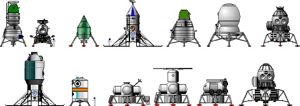
Soviet Lunar Landers
Landing stages for Soviet lunar expeditions. Top row, left to right: L3 original version; LK; LK-3; LK-700; two versions of the L3M; LEK for Energia-launched lunar landing. Bottom row, lunar base elements: Chelomei KLE; Chelomei Heavy Lunokhod; Barmin DLB base module; LZM, LZhM, Lunokhod, and LEK for Glushko LEK Vulkan-launched lunar base.
Credit: © Mark Wade
LEK - Vulkan
LEK - Vulkan-launched version
Credit: © Mark Wade
Vulkan LEK
Vulkan launched Lunar Expeditionary Complex compared with N1-L3
Credit: © Mark Wade
Lunar vehicles
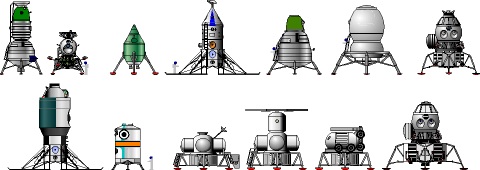
Assorted Soviet Lunar vehicles - clockwise from upper left: LK manned lander. Lunokhod manned traverse crawler. E-6 photographic soft lander. E-8 landing site scout (with solar panels to power homing beacon, soil qualities probe, soil return capsule). Alternate Lunokhod manned rover design.
Credit: Andy Salmon




Chronology
3 events
1975 January 1
- Vulkan Lunar Base - .
Nation: Russia.
Related Persons: Barmin,
Bushuyev,
Glushko,
Mishin.
Program: Lunar L3.
Spacecraft: LEK,
Lunokhod LEK,
LZhM,
LZM.
Mishin and Barmin, using budget provided by the Ministry of Defence, had designed a lunar base for launch by the N1 in 1969-1974. After the cancellation of the N1, Glushko pleaded with the Military-Industrial Commission for the work to be taken from Barmin and be given to NPO Energia. Glushko's alternative, Vulkan-launched base was elaborated within his bureau. Bushuyev developed spacecraft for the base. Prudnikova developed a modular lunar city, with living modules, factory modules, a nuclear reactor power module, and a lunar crawler with a 200 km radius of action. The project work was only finally cancelled after the Apollo-Soyuz flights.
1977 December 1
Launch Vehicle: N1.- Glushko uninterested in further lunar base work - .
Nation: Russia.
Related Persons: Bushuyev.
Spacecraft: Buran,
LEK,
Lunokhod LEK,
LZhM,
LZM.
Bushuyev tells Chertok that the lunar base work did not interest Glushko. The VPK Military-Industrial Commission was only interested in duplicating the American shuttle, not in any other ventures in space. With the N1-Sr booster, Russia could have had a six man lunar base established with 8 to 10 launches in the late 1970's. Bushuyev died on 26 October 1978, having seen his dream completely tossed away.
1978 January 1
- Vulkan Lunar Base rejected - .
Nation: Russia.
Related Persons: Glushko,
Keldysh.
Spacecraft: LEK,
Lunokhod LEK,
LZhM,
LZM.
An expert commission led by Keldysh examines the plan for a lunar base launched by the Vulkan booster. The plan is completely rejected. NPO Energia was told to quit dreaming and devote itself only to projects with national economic importance, like Buran. This put a definitive end to Glushko's lunar base projects studied in 1976-1978. But he just waited and started design work again on a lunar base using the Energia launch vehicle after the first Buran launch in 1988.