Atlas Agena D
Launch vehicle · USA
Original archive entry. The text, images and links below are kept as they were written.

Credit: © Thomas Kladiva - Thomas Kladiva
American orbital launch vehicle. Atlas D with further improved and lightened Agena upper stage.
LEO Payload: 800 kg (1,760 lb). Payload: 1,000 kg (2,200 lb) to a GTO.
Stage Data - Atlas LV-3A / Agena D
- Stage 0. 1 x Atlas MA-5. Gross Mass: 3,646 kg (8,038 lb). Empty Mass: 3,646 kg (8,038 lb). Thrust (vac): 1,896.010 kN (426,240 lbf). Isp: 294 sec. Burn time: 174 sec. Isp(sl): 259 sec. Diameter: 4.90 m (16.00 ft). Span: 4.90 m (16.00 ft).Propellants: Lox/Kerosene. No Engines: 2. Engine: LR-89-7. Status: In Production.
- Stage 1. 1 x Atlas Agena SLV-3A. Gross Mass: 142,000 kg (313,000 lb). Empty Mass: 3,700 kg (8,100 lb). Thrust (vac): 386.300 kN (86,844 lbf). Isp: 316 sec. Burn time: 175 sec. Isp(sl): 220 sec. Diameter: 3.05 m (10.00 ft). Span: 4.90 m (16.00 ft). Length: 20.67 m (67.81 ft). Propellants: Lox/Kerosene. No Engines: 1. Engine: LR-105-7. Status: In Production.
- Stage 2. 1 x Agena D. Gross Mass: 6,821 kg (15,037 lb). Empty Mass: 673 kg (1,483 lb). Thrust (vac): 71.166 kN (15,999 lbf). Isp: 300 sec. Burn time: 265 sec. Diameter: 1.52 m (4.98 ft). Span: 1.52 m (4.98 ft). Length: 7.09 m (23.26 ft). Propellants: Nitric acid/UDMH. No Engines: 1. Engine: Bell 8096. Status: Out of Production. One of the real workhorses of U. S. space exploration, Agena was an upper stage which was also employed as a spacecraft, the whole vehicle going into orbit. Agena played a key role in manned space flight; it was the target vehicle for rendezvous and docking maneuvers in NASA's Gemini project. Agena had a main rocket engine capable of multiple re-starts in space; in the modified target vehicle version it also had 2 secondary engines to provide small changes in velocity and position in orbit. In the Gemini Agena, a control system could handle 96 commands from the astronauts or from ground stations. Agena was used as an upper stage with the Thor, augmented Thor, Atlas and Titan boosters; it had played important roles in such military and NASA programs as Discoverer, Samos, Mariner, OGO, Lunar Orbiter, Ranger and Orbiting Astronomical Observatory.
- Stage 3. 1 x Burner 2. Gross Mass: 774 kg (1,706 lb). Empty Mass: 116 kg (255 lb). Thrust (vac): 43.551 kN (9,791 lbf). Isp: 285 sec. Burn time: 42 sec. Isp(sl): 220 sec. Diameter: 0.66 m (2.16 ft). Span: 0.66 m (2.16 ft). Length: 0.84 m (2.75 ft). Propellants: Solid. No Engines: 1. Engine: Star 37. Status: Out of Production. Burner II was a launch vehicle upper stage developed by Boeing for the Air Force Space Systems Division. It was the first solid-fuel upper stage with full control and guidance capability developed for general space applications. Burner II was designed for use with the Thor booster, but was readily adapted for use on the complete range of standard launch vehicles. Its general assignment was to place small- and medium size payloads into orbit. The Burner II motor, guidance system and reaction control system were integrated to provide attitude stability and precise control of flight rate and burnout velocity for orbital injection and earth-escape missions. Boeing had delivered 8 flight vehicles under its original contract. Under terms of a follow-on contract, it built 6 additional flight models. Four Thor-Burner II combinations were launched successfully from Vandenberg Air Force Base, California. The third launch placed 2 unclassified satellites in Earth orbit. A SECOR satellite, built for the U.S. Army Corps of Engineers by the Cubic Corporation, and an Aurora satellite, developed by Rice University for the Office of Naval Research, were placed in circular orbits 3,300 km above the Earth. As integration contractor for the Air Force Space Experiment Support Program (SESP) Office, Boeing designed, built and tested the injection stage, or "payload dispenser," which carried the 2 satellites on top of a standard Burner II stage and placed them in precise orbits. The satellites were mounted on opposite sides of the injection stage, which housed a640 kgf thrust, solid-propellant rocket motor. The Burner II was used as an upper stage by NASA for deep space probes. Prime Contractor: The Boeing Company. Major Subcontractors Thiokol Chemical Corporation (solid rocket motor); Honeywell Inc. (pre-programmed inertial guidance system); Walter Kidde Co. (reaction control system).
- Stage 4. 1 x Star 17. Gross Mass: 124 kg (273 lb). Empty Mass: 14 kg (30 lb). Thrust (vac): 19.600 kN (4,406 lbf). Isp: 280 sec. Burn time: 18 sec. Isp(sl): 220 sec. Diameter: 0.44 m (1.44 ft). Span: 0.44 m (1.44 ft). Length: 0.98 m (3.21 ft). Propellants: Solid. No Engines: 1. Engine: Star 17. Status: In Production.
More at: Atlas Agena D.
Related
- Family
- orbital launch vehicle
- Country
- USA
- Projects
- Mariner
- Launch Sites
- Cape Canaveral, Vandenberg, Cape Canaveral LC12, Cape Canaveral LC13, Vandenberg SLC4W
- Stages
- Agena D, Atlas MA-5, Atlas Agena SLV-3A, Star 17, Star 37
- Agency
- Convair
Photo Gallery
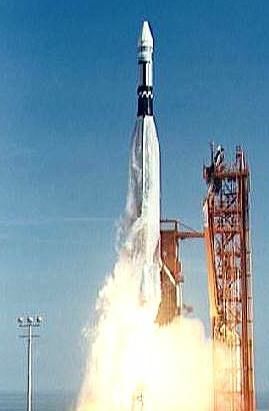
Atlas ATDA
Credit: US Air Force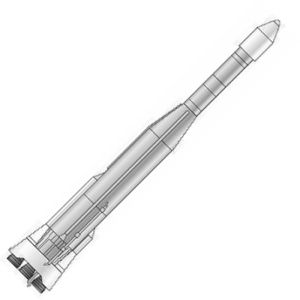
Atlas Agena D
Credit: © Mark Wade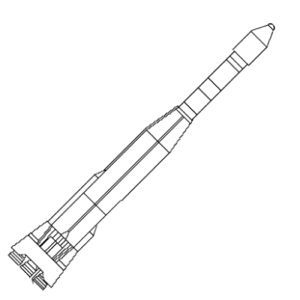
Atlas Agena D
Credit: © Mark Wade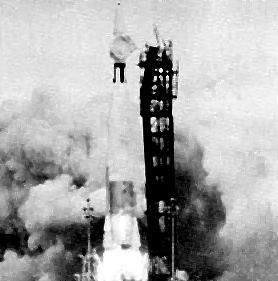
Atlas Agena
First Atlas Agena - Agena s/n 1008 - Midas 1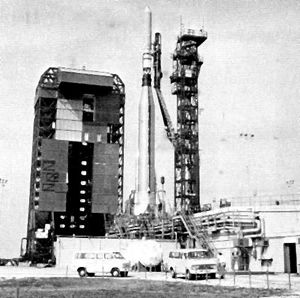
Atlas Agena
Last Atlas Agena - Agena s/n P113 - 6 April 1978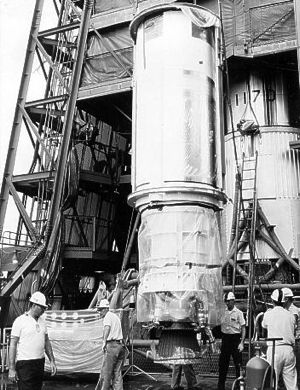
Agena D
Agena D rocket stage being raised for mating with Atlas launch vehicle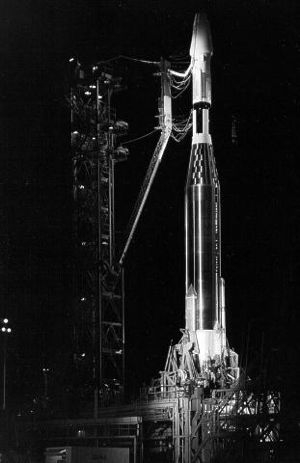
Atlas Agena
Atlas Agena / Ranger C launch vehicle


Chronology
18 events
1961 August 25
LV Family: Thor, Atlas. Launch Vehicle: Atlas Agena D, Thor Agena D.- Lockheed contracted for the Agena D upper stage. - . Lockheed was awarded an Air Force letter contract to develop and manufacture the first 12 flight models of the standardized configuration Agena D (Standard Stage OlA, SS-01A)..
1962 May 29
LV Family: Atlas, Thor. Launch Vehicle: Atlas Agena D, Thor Agena D.- Standardized Agena D upper stage for use with Atlas and Thor. - .
The Defense Department and NASA signed a joint agreement that authorized the Defense Department to develop a standardized Agena D upper stage for joint use with Atlas and Thor booster stages. The Agena would use present flight-proven equipment, stress simplification of vehicle design, permit adaptability to advanced components without any basic changes, and permit production at lower costs.
1963 April 27
Launch Site: Cape Canaveral. LV Family: Atlas. Launch Vehicle: Atlas Agena D.- LC 14 modifications - .
Nation: USA.
Final design review of complex 14 modifications and activation of facilities was held under the aegis of Air Force Space Systems Division (SSD) in Los Angeles. All drawings and specifications were accepted. SSD's activation of the complex was scheduled to begin January 1, 1964, with an estimated 10 months required to prepare complex 14 for Project Gemini Atlas-Agena launches.
1963 July 12
20:45 GMT - . Launch Site: Vandenberg. Launch Complex: Vandenberg SLC4W. LV Family: Atlas. Launch Vehicle: Atlas Agena D.- KH 7-01 (Gambit) - .
Payload: KH-7 no. 1 / OPS 1467. Mass: 2,000 kg (4,400 lb). Nation: USA.
Agency: NRO,
USAF.
Class: Surveillance.
Type: Military surveillance satellite. Spacecraft Bus: WS-117.
Spacecraft: KH-7.
Decay Date: 1963-07-17 . USAF Sat Cat: 618 . COSPAR: 1963-028A. Apogee: 212 km (131 mi). Perigee: 173 km (107 mi). Inclination: 95.30 deg. Period: 88.30 min.
The Air Force launched its first Atlas D/Agena D from Vandenberg. This was the 100th Agena (Number 4702) space vehicle used since 28 February 1959. KH-7 type satellite. Space craft engaged in investigation of spaceflight techniques and technology (US Cat A).
1963 September 6
19:30 GMT - . Launch Site: Vandenberg. Launch Complex: Vandenberg SLC4W. LV Family: Atlas. Launch Vehicle: Atlas Agena D.- KH 7-02 - . Payload: KH-7 no. 2 / OPS 1947. Mass: 2,000 kg (4,400 lb). Nation: USA. Agency: NRO, USAF. Class: Surveillance. Type: Military surveillance satellite. Spacecraft Bus: WS-117. Spacecraft: KH-7. Decay Date: 1963-09-13 . USAF Sat Cat: 641 . COSPAR: 1963-036A. Apogee: 243 km (150 mi). Perigee: 171 km (106 mi). Inclination: 94.40 deg. Period: 88.70 min. KH-7 type satellite. Space craft engaged in investigation of spaceflight techniques and technology (US Cat A). .
1963 October 17
02:37 GMT - . Launch Site: Cape Canaveral. Launch Complex: Cape Canaveral LC13. LV Family: Atlas. Launch Vehicle: Atlas Agena D.- Vela 2 - .
Payload: Vela 1B. Mass: 220 kg (480 lb). Nation: USA.
Agency: USAF.
Class: Surveillance.
Type: Nuclear detection surveillance satellite. Spacecraft: Vela.
USAF Sat Cat: 674 . COSPAR: 1963-039A. Apogee: 116,582 km (72,440 mi). Perigee: 101,081 km (62,808 mi). Inclination: 38.70 deg. Period: 6,486.20 min.
Space Systems Division, acting.as program manager for the Defense Department, launched two Vela nuclear radiation detection satellites from Cape Canaveral aboard the first Atlas D/Agena D (SLV-3/SS-01A) launch vehicle (197D). The Vela satellites were developed and produced by the TRW Systems and were the first pair in a series of satellites designed to provide information on nuclear detonations in the atmosphere or in outer space to a distance of 100 million miles. The 297-pound satellites were placed in near-circular orbits approximately 70,000 miles above the Earth's surface. Space craft engaged in investigation of spaceflight techniques and technology (US Cat A).
- Vela 1 - . Payload: Vela 1A. Mass: 220 kg (480 lb). Nation: USA. Agency: USAF. Class: Surveillance. Type: Nuclear detection surveillance satellite. Spacecraft: Vela. USAF Sat Cat: 692 . COSPAR: 1963-039C. Apogee: 116,528 km (72,407 mi). Perigee: 101,925 km (63,333 mi). Inclination: 37.80 deg. Period: 6,519.60 min. Space craft engaged in investigation of spaceflight techniques and technology (US Cat A)..
- TRS 5 - . Payload: ERS 12. Mass: 2.00 kg (4.40 lb). Nation: USA. Agency: USAF. Class: Technology. Type: Navigation technology satellite. Spacecraft: TRS. Decay Date: 1963-06-30 . USAF Sat Cat: 675 . COSPAR: 1963-039B. Apogee: 102,372 km (63,610 mi). Perigee: 953 km (592 mi). Inclination: 35.90 deg. Period: 2,319.40 min. Decay date suspect Space craft engaged in investigation of spaceflight techniques and technology (US Cat A)..
1963 October 25
Launch Site: Vandenberg. Launch Complex: Vandenberg SLC4W. LV Family: Atlas. Launch Vehicle: Atlas Agena D.- Agena D - . Mass: 2,000 kg (4,400 lb). Nation: USA. Agency: USAF. Spacecraft Bus: WS-117. Spacecraft: KH-7. Decay Date: 1963-10-31 . USAF Sat Cat: 678 . COSPAR: 1963-041B. Apogee: 276 km (171 mi). Perigee: 116 km (72 mi). Inclination: 99.00 deg. Period: 88.41 min. Space craft engaged in investigation of spaceflight techniques and technology (US Cat A). .
- KH 7-03 - . Payload: KH-7 no. 3 / OPS 2196. Mass: 2,000 kg (4,400 lb). Nation: USA. Agency: NRO, USAF. Class: Surveillance. Type: Military surveillance satellite. Spacecraft Bus: WS-117. Spacecraft: KH-7. Decay Date: 1963-10-29 . USAF Sat Cat: 677 . COSPAR: 1963-041A. Apogee: 312 km (193 mi). Perigee: 123 km (76 mi). Inclination: 99.00 deg. Period: 88.80 min. KH-7 type satellite. Space craft engaged in investigation of spaceflight techniques and technology (US Cat A). .
1963 December 18
21:45 GMT - . Launch Site: Vandenberg. Launch Complex: Vandenberg SLC4W. LV Family: Atlas. Launch Vehicle: Atlas Agena D.- KH 7-04 - .
Payload: KH-7 no. 4 / OPS 2372. Mass: 2,000 kg (4,400 lb). Nation: USA.
Agency: NRO,
USAF.
Class: Surveillance.
Type: Military surveillance satellite. Spacecraft Bus: WS-117.
Spacecraft: KH-7.
Decay Date: 1963-12-20 . USAF Sat Cat: 711 . COSPAR: 1963-051A. Apogee: 266 km (165 mi). Perigee: 122 km (75 mi). Inclination: 97.90 deg. Period: 88.50 min.
Atlas 109F was the final Atlas research and development flight test missile to be launched. Since the first attempted launch of a Series A Atlas on 11 June 1957, 95 Atlas missiles had been used in the R&D program - eight As, nine Bs, six Cs, 32 Ds, 24 Es, and 16 Fs. All but 12 of these were launched from Cape Canaveral. Of the 95 launches, 57 were considered successful while 38 were failures. KH-7 type satellite. Space craft engaged in investigation of spaceflight techniques and technology (US Cat A).
1964 February 25
18:59 GMT - . Launch Site: Vandenberg. Launch Complex: Vandenberg SLC4W. LV Family: Atlas. Launch Vehicle: Atlas Agena D.- KH 7-05 - . Payload: KH-7 no. 5 / OPS 2423. Mass: 2,000 kg (4,400 lb). Nation: USA. Agency: NRO, USAF. Class: Surveillance. Type: Military surveillance satellite. Spacecraft Bus: WS-117. Spacecraft: KH-7. Decay Date: 1964-03-01 . USAF Sat Cat: 754 . COSPAR: 1964-009A. Apogee: 135 km (83 mi). Perigee: 135 km (83 mi). Inclination: 95.60 deg. Period: 87.20 min. KH-7 type satellite. Space craft engaged in investigation of spaceflight techniques and technology (US Cat A)..
1964 March 11
20:14 GMT - . Launch Site: Vandenberg. Launch Complex: Vandenberg SLC4W. LV Family: Atlas. Launch Vehicle: Atlas Agena D.- KH 7-06 - . Payload: KH-7 no. 6 / OPS 3435. Mass: 2,000 kg (4,400 lb). Nation: USA. Agency: NRO, USAF. Class: Surveillance. Type: Military surveillance satellite. Spacecraft Bus: WS-117. Spacecraft: KH-7. Decay Date: 1964-03-16 . USAF Sat Cat: 764 . COSPAR: 1964-012A. Apogee: 203 km (126 mi). Perigee: 163 km (101 mi). Inclination: 95.70 deg. Period: 88.20 min. KH-7 type satellite. Space craft engaged in investigation of spaceflight techniques and technology (US Cat A). .
1964 April 23
16:19 GMT - . Launch Site: Vandenberg. Launch Complex: Vandenberg SLC4W. LV Family: Atlas. Launch Vehicle: Atlas Agena D.- KH 7-07 - . Payload: KH-7 no. 7 / OPS 3743. Mass: 2,000 kg (4,400 lb). Nation: USA. Agency: NRO, USAF. Class: Surveillance. Type: Military surveillance satellite. Spacecraft Bus: WS-117. Spacecraft: KH-7. Decay Date: 1964-04-29 . USAF Sat Cat: 786 . COSPAR: 1964-020A. Apogee: 336 km (208 mi). Perigee: 150 km (90 mi). Inclination: 103.60 deg. Period: 89.40 min. KH-7 type satellite. Space craft engaged in investigation of spaceflight techniques and technology (US Cat A). .
1964 May 19
19:21 GMT - . Launch Site: Vandenberg. Launch Complex: Vandenberg SLC4W. LV Family: Atlas. Launch Vehicle: Atlas Agena D.- KH 7-08 - . Payload: KH-7 no. 8 / OPS 3592. Mass: 2,000 kg (4,400 lb). Nation: USA. Agency: NRO, USAF. Class: Surveillance. Type: Military surveillance satellite. Spacecraft Bus: WS-117. Spacecraft: KH-7. Decay Date: 1964-05-22 . USAF Sat Cat: 799 . COSPAR: 1964-024A. Apogee: 380 km (230 mi). Perigee: 141 km (87 mi). Inclination: 101.10 deg. Period: 89.70 min. KH-7 type satellite. Space craft engaged in investigation of spaceflight techniques and technology (US Cat A). .
1964 July 6
18:51 GMT - . Launch Site: Vandenberg. Launch Complex: Vandenberg SLC4W. LV Family: Atlas. Launch Vehicle: Atlas Agena D.- KH 7-09 - . Payload: KH-7 no. 9 / OPS 3684. Mass: 2,000 kg (4,400 lb). Nation: USA. Agency: NRO, USAF. Class: Surveillance. Type: Military surveillance satellite. Spacecraft Bus: WS-117. Spacecraft: KH-7. Decay Date: 1964-07-08 . USAF Sat Cat: 825 . COSPAR: 1964-036A. Apogee: 345 km (214 mi). Perigee: 121 km (75 mi). Inclination: 92.90 deg. Period: 89.10 min. KH-7 type satellite. Space craft engaged in investigation of spaceflight techniques and technology (US Cat A). .
- OPS 4923 - . Payload: EHH A3. Mass: 80 kg (176 lb). Nation: USA. Agency: NRO, USAF. Class: Surveillance. Type: SIGINT. Spacecraft Bus: P 11. Spacecraft: SSF. Decay Date: 1965-01-03 . USAF Sat Cat: 826 . COSPAR: 1964-036B. Apogee: 505 km (313 mi). Perigee: 156 km (96 mi). Inclination: 92.90 deg. Period: 91.10 min. Radar monitoring..
1964 July 17
08:22 GMT - . Launch Site: Cape Canaveral. Launch Complex: Cape Canaveral LC13. LV Family: Atlas. Launch Vehicle: Atlas Agena D.- Vela 3 - .
Payload: Vela 2A / OPS 3662. Mass: 220 kg (480 lb). Nation: USA.
Agency: USAF.
Class: Surveillance.
Type: Nuclear detection surveillance satellite. Spacecraft: Vela.
USAF Sat Cat: 836 . COSPAR: 1964-040A. Apogee: 104,101 km (64,685 mi). Perigee: 102,500 km (63,600 mi). Inclination: 39.10 deg. Period: 6,024.80 min.
An Atlas D/Agena D launch vehicle (Atlas 216D), carrying the second set of Vela Nuclear Detection Satellites, was launched from Cape Canaveral and placed the satellites in their prescribed orbits. Space craft engaged in investigation of spaceflight techniques and technology (US Cat A).
- Vela 4 - .
Payload: Vela 2B / OPS 3674. Mass: 220 kg (480 lb). Nation: USA.
Agency: USAF.
Class: Surveillance.
Type: Nuclear detection surveillance satellite. Spacecraft: Vela.
USAF Sat Cat: 837 . COSPAR: 1964-040B. Apogee: 114,000 km (70,000 mi). Perigee: 92,103 km (57,230 mi). Inclination: 40.80 deg. Period: 6,004.30 min.
An Atlas D/Agena D launch vehicle (Atlas 216D), carrying the second set of Vela Nuclear Detection Satellites, was launched from Cape Canaveral and placed the satellites in their prescribed orbits. Space craft engaged in investigation of spaceflight techniques and technology (US Cat A).
- TRS 6 - . Payload: ERS 13. Mass: 12 kg (26 lb). Nation: USA. Agency: USAF. Class: Technology. Type: Navigation technology satellite. Spacecraft: TRS. Decay Date: 1966-07-01 . USAF Sat Cat: 838 . COSPAR: 1964-040C. Apogee: 104,665 km (65,035 mi). Perigee: 217 km (134 mi). Inclination: 36.70 deg. Period: 2,366.20 min. Decay date suspect Space craft engaged in investigation of spaceflight techniques and technology (US Cat A)..
1964 October 23
18:30 GMT - . Launch Site: Vandenberg. Launch Complex: Vandenberg SLC4W. LV Family: Atlas. Launch Vehicle: Atlas Agena D.- KH 7-13 - . Payload: KH-7 no. 13 / OPS 4384. Mass: 2,000 kg (4,400 lb). Nation: USA. Agency: NRO, USAF. Class: Surveillance. Type: Military surveillance satellite. Spacecraft Bus: WS-117. Spacecraft: KH-7. Decay Date: 1964-10-28 . USAF Sat Cat: 912 . COSPAR: 1964-068A. Apogee: 267 km (165 mi). Perigee: 140 km (80 mi). Inclination: 95.50 deg. Period: 88.50 min. KH-7 type satellite. Space craft engaged in investigation of spaceflight techniques and technology (US Cat A). .
- SRV - . Nation: USA. Agency: USAF AFSC. Class: Surveillance. Type: SIGINT. Spacecraft Bus: P 11. Spacecraft: SSF. Decay Date: 1965-02-23 . USAF Sat Cat: 914 . COSPAR: 1964-068xx. Apogee: 185 km (114 mi). Perigee: 185 km (114 mi). Inclination: 95.40 deg. Period: 88.20 min.
- OPS 5063 - . Payload: EHH A4. Mass: 60 kg (132 lb). Nation: USA. Agency: NRO, USAF. Spacecraft Bus: WS-117. Spacecraft: KH-7. Decay Date: 1965-02-23 . USAF Sat Cat: 914 . COSPAR: 1964-068B. Apogee: 344 km (213 mi). Perigee: 311 km (193 mi). Inclination: 95.50 deg. Period: 91.10 min. Radar monitoring..
1964 November 5
19:22 GMT - . Launch Site: Cape Canaveral. Launch Complex: Cape Canaveral LC13. LV Family: Atlas. Launch Vehicle: Atlas Agena D. FAILURE: Launch fairing failure. Failed Stage: S.- Mariner 3 - . Payload: Mariner C-2. Mass: 260 kg (570 lb). Nation: USA. Agency: JPL, NASA. Program: Mariner. Class: Mars. Type: Mars probe. Spacecraft Bus: Mariner. Spacecraft: Mariner 3-4. USAF Sat Cat: 923 . COSPAR: 1964-073A. Mars probe; launch fairing failure prevented Mars flyby. Solar Orbit (Heliocentric). Spacecraft engaged in research and exploration of the upper atmosphere or outer space (US Cat B)..
1964 November 28
14:22 GMT - . Launch Site: Cape Canaveral. Launch Complex: Cape Canaveral LC12. LV Family: Atlas. Launch Vehicle: Atlas Agena D.- Mariner 4 - .
Payload: Mariner C-3. Mass: 260 kg (570 lb). Nation: USA.
Agency: JPL,
NASA.
Program: Mariner.
Class: Mars.
Type: Mars probe. Spacecraft Bus: Mariner.
Spacecraft: Mariner 3-4.
USAF Sat Cat: 938 . COSPAR: 1964-077A.
Mariner 4 provided the first up close pictures of Mars. The protective shroud covering Mariner 4 was jettisoned and the Agena D/Mariner 4 combination separated from the Atlas D booster at 14:27:23 GMT on 28 November 1964. The Agena D first burn from 14:28:14 to 14:30:38 put the spacecraft into an Earth parking orbit and the second burn from 15:02:53 to 15:04:28 injected the craft into a Mars transfer orbit. Mariner 4 separated from the Agena D at 15:07:09 and began cruise mode operations. The solar panels deployed and the scan platform was unlatched at 15:15:00 and Sun acquisition occurred 16 minutes later. A midcourse maneuver made on 5 December 1964.
After a 228 day cruise, the spacecraft flew by Mars on July 14 and 15, 1965. Planetary science mode was turned on at 15:41:49 GMT on 14 July. The camera sequence started at 00:18:36 GMT on July 15 and 21 pictures plus 21 lines of a 22nd picture were taken. The images covered a discontinuous swath of Mars starting near 40 N, 170 E, down to about 35 S, 200 E, and then across to the terminator at 50 S, 255 E, representing about 1% of the planet's surface. The closest approach was 9,846 km from the Martian surface at 01:00:57 GMT 15 July 1965. The images taken during the flyby were stored in the onboard tape recorder. At 02:19:11 GMT Mariner 4 passed behind Mars as seen from Earth and the radio signal ceased. The signal was reacquired at 03:13:04 GMT when the spacecraft reappeared. Cruise mode was then re-established. Transmission of the taped images to Earth began about 8.5 hours after signal reacquisition and continued until 3 August. All images were transmitted twice to insure no data was missing or corrupt.
The spacecraft performed all programmed activities successfully and returned useful data from launch until 22:05:07 GMT on 1 October 1965, when the distance from Earth (309.2 million km) and the antenna orientation temporarily halted signal acquisition. In 1967 Mariner 4 returned to the vicinity of Earth again and engineers decided to use the ageing craft for a series of operational and telemetry tests to improve their knowledge of the technologies that would be needed for future interplanetary spacecraft. The cosmic dust detector registered 17 hits in a 15 minute span on 15 September, part of an apparent micrometeoroid shower which temporarily changed the spacecraft attitude and probably slightly damaged the thermal shield. On 7 December the gas supply in the attitude control system was exhausted, and on December 10 and 11 a total of 83 micrometeoroid hits were recorded which caused perturbation of the attitude and degradation of the signal strength. On 21 December 1967 communications with Mariner 4 were terminated.
Results
The total data returned by the mission was 5.2 million bits. All experiments operated successfully with the exception of the ionization chamber/Geiger counter which failed in February, 1965 and the plasma probe, which had its performance degraded by a resistor failure on 6 December 1964. The images returned showed a Moon-like cratered terrain (which later missions showed was not typical for Mars, but only for the more ancient region imaged by Mariner 4). A surface atmospheric pressure of 4.1 to 7.0 mb was estimated and no magnetic field was detected.
1965 July 20
08:27 GMT - . Launch Site: Cape Canaveral. Launch Complex: Cape Canaveral LC13. LV Family: Atlas. Launch Vehicle: Atlas Agena D.- Vela 5 - . Payload: Vela 3A / OPS 6577. Mass: 235 kg (518 lb). Nation: USA. Agency: USAF. Class: Surveillance. Type: Nuclear detection surveillance satellite. Spacecraft: Vela. USAF Sat Cat: 1458 . COSPAR: 1965-058A. Apogee: 115,839 km (71,978 mi). Perigee: 106,367 km (66,093 mi). Inclination: 35.20 deg. Period: 6,679.00 min. Air Force Atlas/Agena D lifted the third pair of Vela nuclear detection satellites into their 70,000-mile, nearly circular orbits. Space craft engaged in investigation of spaceflight techniques and technology (US Cat A)..
- ORS 3 - . Payload: ERS 17. Mass: 5.00 kg (11.00 lb). Nation: USA. Agency: USAF. Class: Earth. Type: Magnetosphere satellite. Spacecraft: ERS. Decay Date: 1968-07-01 . USAF Sat Cat: 1460 . COSPAR: 1965-058C. Apogee: 111,793 km (69,464 mi). Perigee: 566 km (351 mi). Inclination: 36.90 deg. Period: 2,595.40 min. Radiation data. Space craft engaged in investigation of spaceflight techniques and technology (US Cat A). .
- Vela 6 - . Payload: Vela 3B / OPS 6564. Mass: 235 kg (518 lb). Nation: USA. Agency: USAF. Class: Surveillance. Type: Nuclear detection surveillance satellite. Spacecraft: Vela. USAF Sat Cat: 1459 . COSPAR: 1965-058B. Apogee: 121,281 km (75,360 mi). Perigee: 101,715 km (63,202 mi). Inclination: 34.20 deg. Period: 6,712.70 min. An Air Force Atlas/Agena D lifted the third pair of Vela nuclear detection satellites into their 70,000-mile, nearly circular orbits. Space craft engaged in investigation of spaceflight techniques and technology (US Cat A)..